Category: Companies

  • RT Pastry at 13.5 Sen: Three Things That Caught My Attention

    RT Pastry at 13.5 Sen: Three Things That Caught My Attention

    A layperson’s look at the 0.19% online clue, halal/Shariah positioning and what I saw in the shops.

    Disclosure: I own shares in RT Pastry Holdings Berhad. This article reflects my personal views and is for information and commentary only. It is not investment advice or a recommendation to buy, sell or hold any security. Please do your own research and seek professional advice where appropriate.

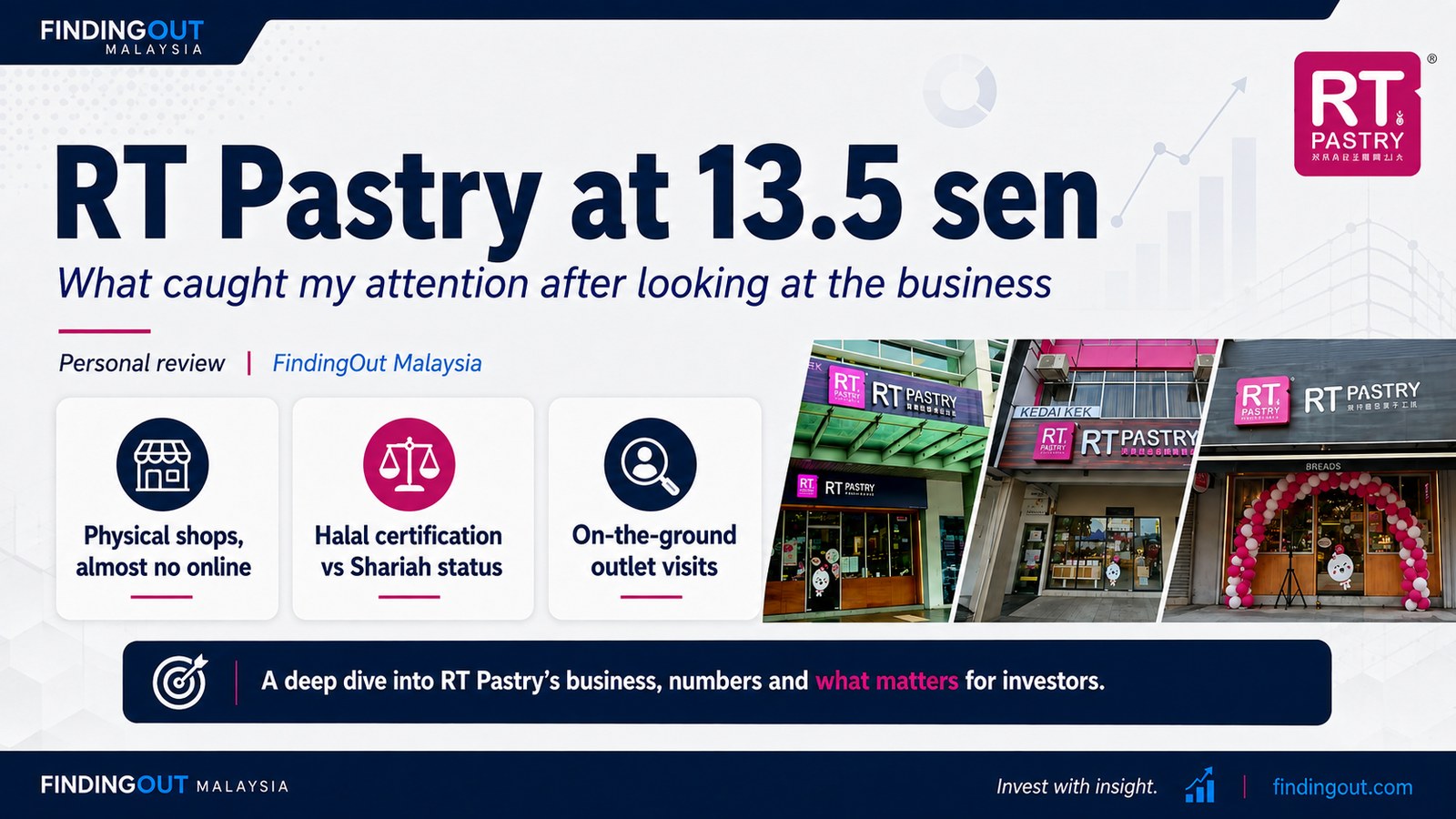
    RT Pastry at 13.5 Sen

    RT Pastry is not the sort of investment idea that needs an elaborate story. It makes bread, cakes and pastries, listed on Bursa Malaysia’s ACE Market on 29 June 2026 at 18 sen a share, and closed at 13.5 sen on Monday, 24 August 2026 – 25% below the IPO price. [2] [9]

    That fall is what makes the stock noticeable, but it is not what makes the story interesting to me. I am more interested in three practical observations: online sales are still almost invisible, the halal position has improved while the shares remain Shariah non-compliant, and I have actually spent time looking at the business in its shops.

    Those three angles are the heart of this commentary. The financial accounts and valuation still matter, but I would rather ask whether an established bakery can reach more customers and whether that opportunity starts to show up in sales, margins and cash generation.

    1. The 0.19% clue: online sales are still almost invisible

    The single number that caught my attention most was not 13.5 sen. It was 0.19%.

    For Q1 FY2026, RT Pastry recorded revenue of RM12.657 million. Physical retail outlets contributed 96.45% of total sales, wholesale contributed 3.36%, and the company’s own online platform contributed only about RM24,000 – 0.19%. [3]
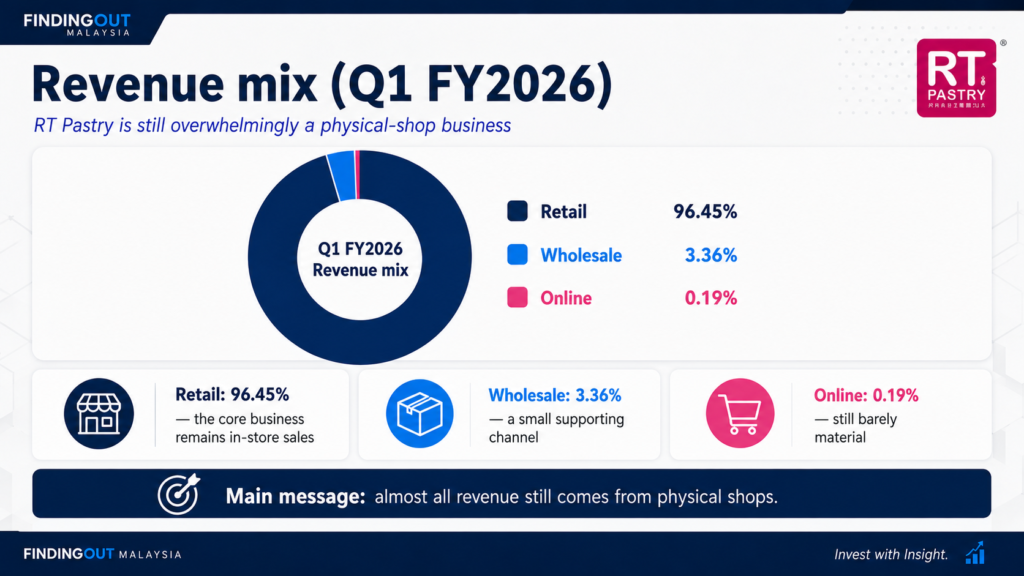
    RT Pastry Q1 FY2026 revenue mix: 96.45% retail, 3.36% wholesale and 0.19% online sales.

    RT Pastry Q1 FY2026 Revenue Mix

    To me, this is both a weakness and an opportunity. RT Pastry already operates an online shop, so it is not starting from zero. But economically, digital sales are still tiny compared with the physical network. [1]

    Could delivery become another shopfront?

    An office ordering pastries for a meeting, a family wanting a cake delivered, or someone buying breakfast without travelling to a store are ordinary use cases. If RT Pastry can place more of its range where customers already search for food – through its own shop, delivery partners or larger marketplaces – each outlet could potentially reach beyond its immediate catchment without a new shop for every new customer.

    I would not assume this is free growth. Delivery commissions, packaging, promotions, fulfilment and possible cannibalisation of walk-in sales can dilute the benefit. The relevant test is not whether online orders increase; it is whether incremental digital revenue can be earned at a sensible margin.

    What I will watch: online contribution, repeat digital ordering, delivery economics and whether digital reach adds customers rather than simply shifting existing store sales.

    2. Halal certification and Shariah status: two different issues, one important checkpoint

    My second angle is the Muslim consumer and investor market, but two ideas have to stay separate: halal certification of the food/manufacturing business and Shariah-compliant status of the shares are not the same thing.

    RT Pastry’s Plant 2 facility in Glenmarie has held JAKIM halal certification since 2023. Plant 1 in Taman Bukit Serdang obtained JAKIM certification effective 1 July 2026, valid until 30 June 2028. That means both central manufacturing plants now have halal certification. [5] [6]
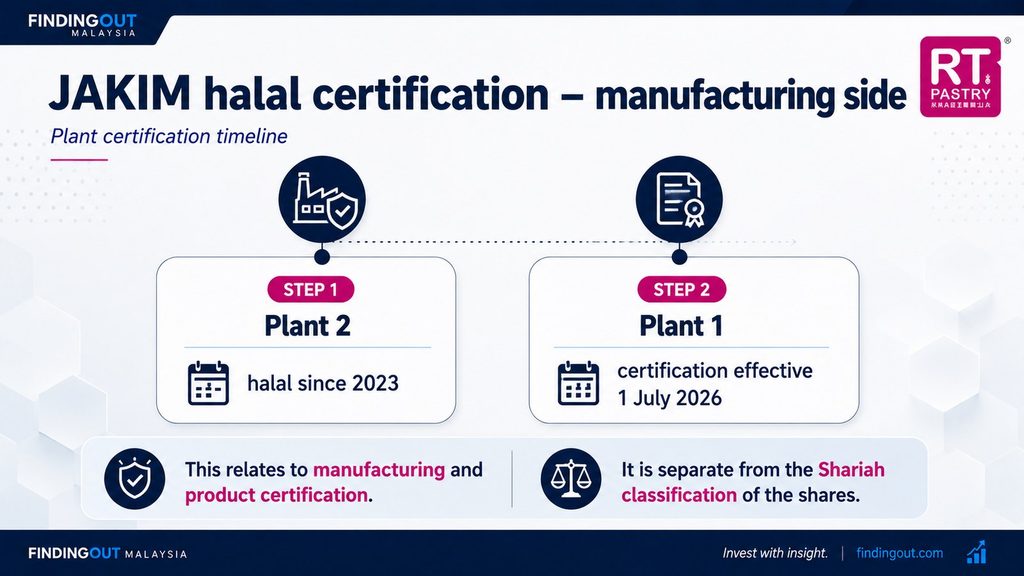
    Timeline of JAKIM halal certification for RT Pastry Plant 2 in Glenmarie and Plant 1 in Taman Bukit Serdang.

    RT Pastry Halal Certification Timeline

    Commercially, I think that matters. Management has talked about broadening market reach beyond the Klang Valley, strengthening wholesale distribution and developing OEM business. A stronger halal platform could help the company reach Muslim consumers and corporate customers with clearer assurance. [4] [6]

    But the shares themselves are currently classified as Shariah non-compliant on the Securities Commission Malaysia’s pre-listing status page, updated on 11 June 2026. The SC screening process considers business activities as well as financial-ratio benchmarks, so halal certification does not automatically change the share classification. [7] [8]
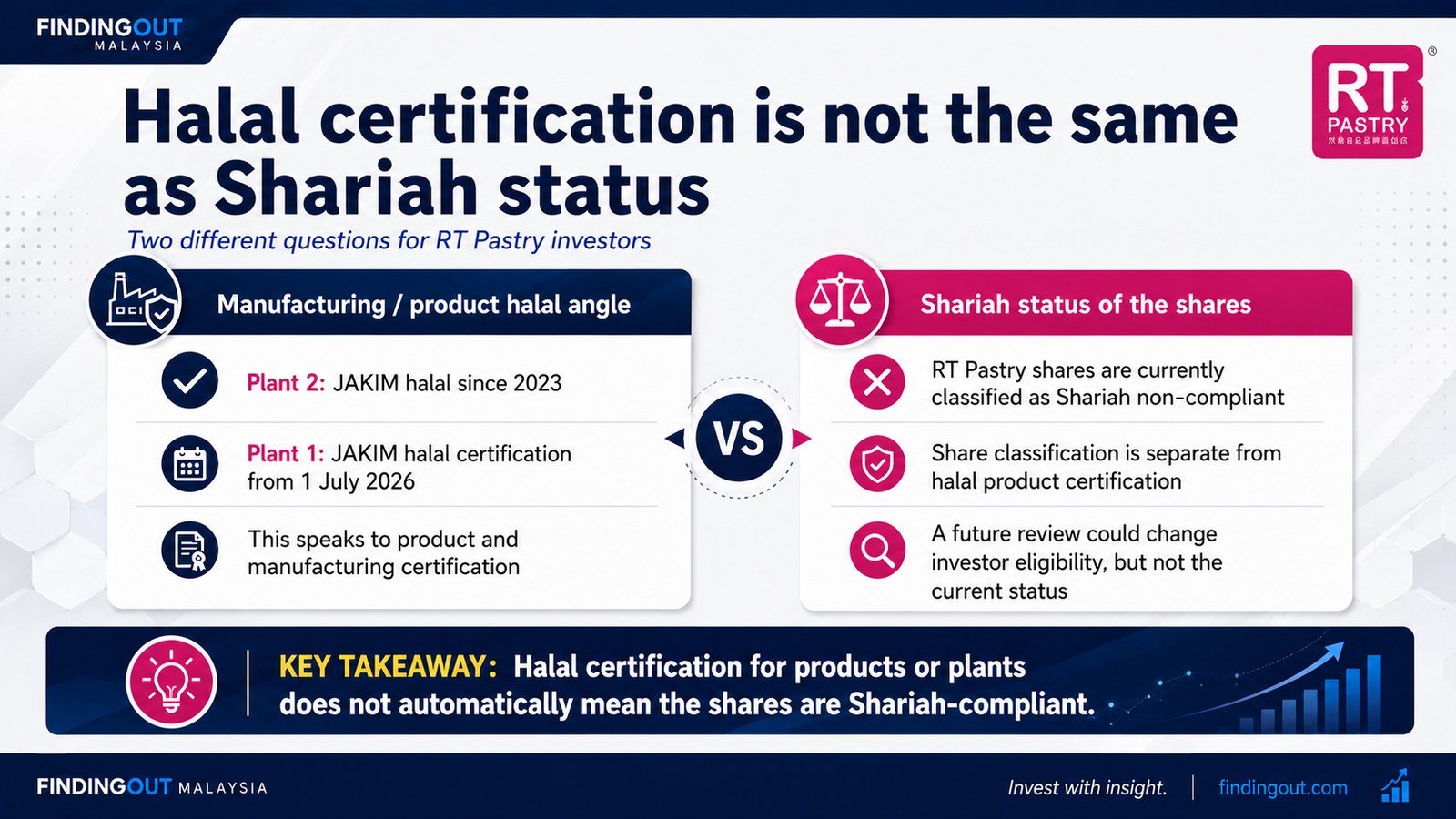
    RT Pastry halal certification compared with the Shariah-compliant status of its shares, showing that the two are separate issues.

    RT Pastry Halal vs Shariah Status

    One outlet-level observation – not a regulatory finding

    At the Taman Segar and Taman Desa outlets I visited, I did not see the familiar JAKIM halal logo displayed at the shopfront. I treat that only as a personal observation. Before publication I could verify the central manufacturing certification; I have not independently established separate outlet-level JAKIM certification for those two branches. [11]

    The SC says its Shariah-compliant securities list is updated twice a year, in May and November. That makes the next November review – scheduled for 27 November 2026 – a natural checkpoint for me to watch, not something I would predict in advance. [8]

    3. What I saw in the shops: anecdotal, but still worth noticing

    My third angle is the least scientific, but it is the most personal.

    I have visited RT Pastry outlets in Taman Segar and Taman Desa on several occasions. I have not conducted formal customer counts and two branches cannot represent an entire business. Nevertheless, the stores I visited appeared to have a fairly steady flow of customers. I also noticed Muslim customers purchasing products. [11]
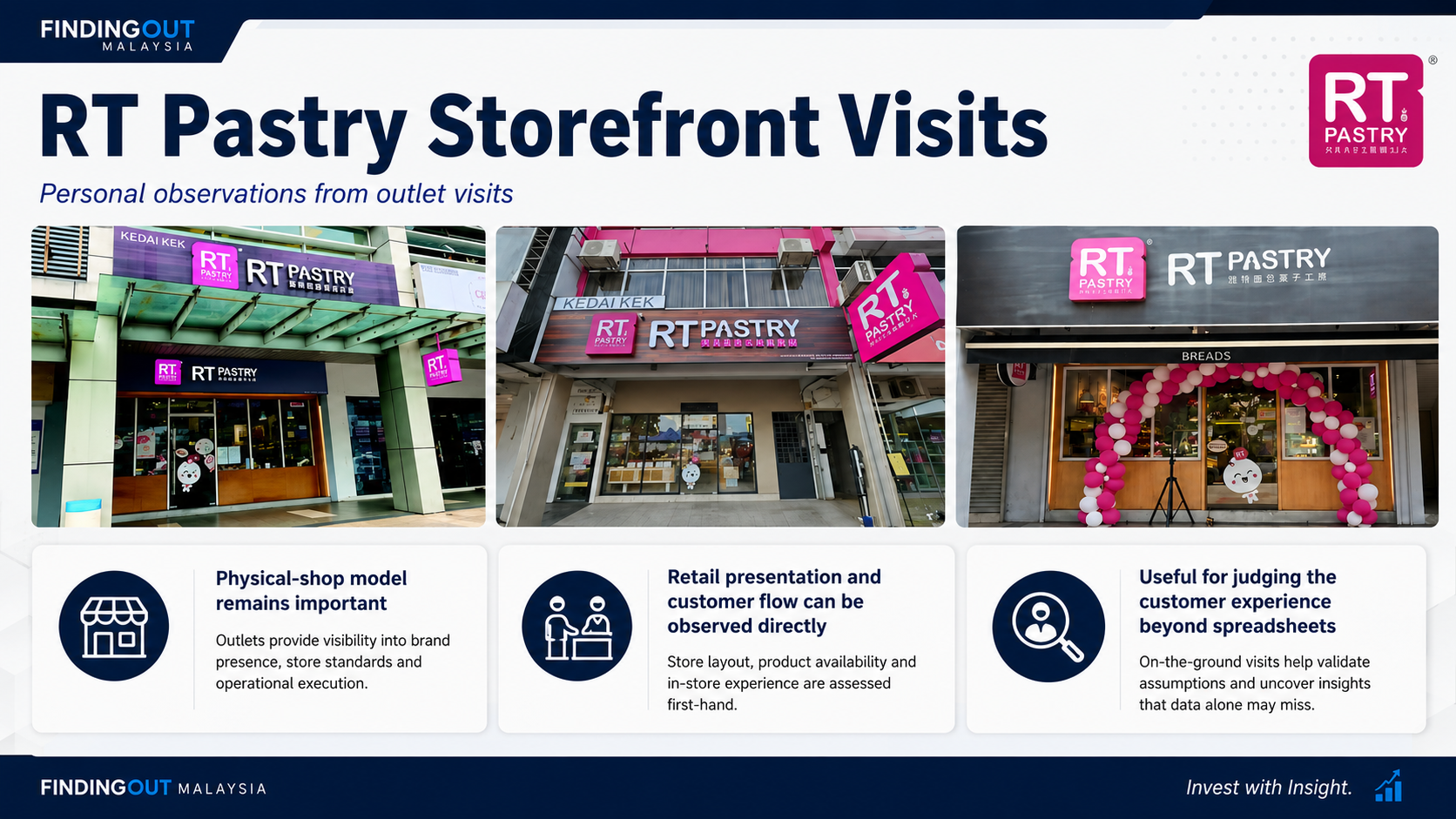
    RT Pastry storefront visits in Taman Segar and Taman Desa observed for FindingOut's personal commentary.

    RT Pastry Storefront Visits

    This does not prove same-store sales are rising or that every outlet is busy. But it gave me a reason to look further. The shops I saw did not feel like a brand customers had deserted. For a consumer business, I think that sort of real-world observation is worth placing beside the accounts – carefully, without pretending it is hard data.

    RT Pastry’s current website says the brand has 18 outlets across the Klang Valley and more than 500 bakery products. At the IPO it had 17 outlets, so the physical network has already moved forward at least one step. [1] [2]
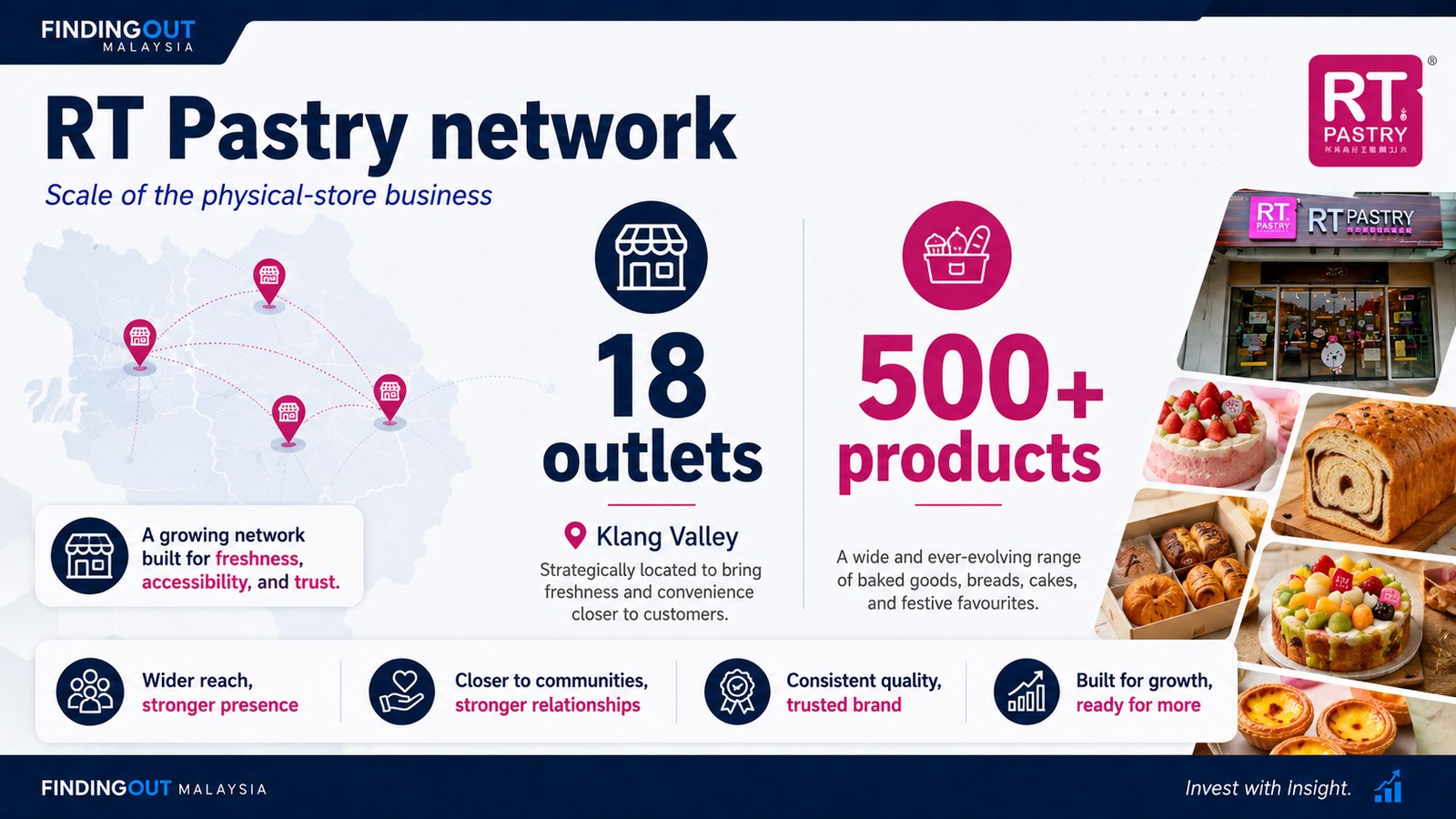
    RT Pastry network showing 18 outlets across the Klang Valley and more than 500 bakery products.

    RT Pastry 18 Outlets and 500 Plus Products

    Why the physical network matters

    A store-led business has disadvantages – rent, labour and the need to attract local footfall – but it also gives RT Pastry a tangible customer relationship. The investment question is whether that physical base can become a platform for wider distribution rather than remaining the only meaningful channel.

    My takeaway: the stores are not proof of growth, but they are evidence worth testing against future revenue, margins and customer reach.

    4. What does 13.5 sen actually mean?

    A price 25% below the IPO price can look cheap, but a lower share price is not the same thing as a lower-risk investment. I therefore prefer to anchor the valuation to what the company has actually earned.

    With 339.042 million shares after the IPO, 13.5 sen implies a market capitalisation of roughly RM45.8 million. Against FY2025 profit attributable to owners of RM6.006 million, that is about 7.6 times reported earnings. The prospectus also discloses that FY2025 included a net RM0.746 million gain on the disposal of the Balakong plant; excluding that gain, attributable profit was RM5.260 million and the same 13.5-sen reference price equates to about 8.7 times adjusted earnings. [2]

    The history is steady rather than spectacular. Revenue rose from RM54.747 million in FY2022 to RM60.312 million in FY2025. Attributable profit was RM5.877 million, RM6.234 million, RM5.013 million and RM6.006 million across FY2022-FY2025. [2]

    The Q1 reality check

    Q1 FY2026 revenue was RM12.657 million, profit attributable to owners was about RM370,000 and gross margin was 29.23%, below FY2025’s 35.36%. That is a legitimate reason for caution. [3]
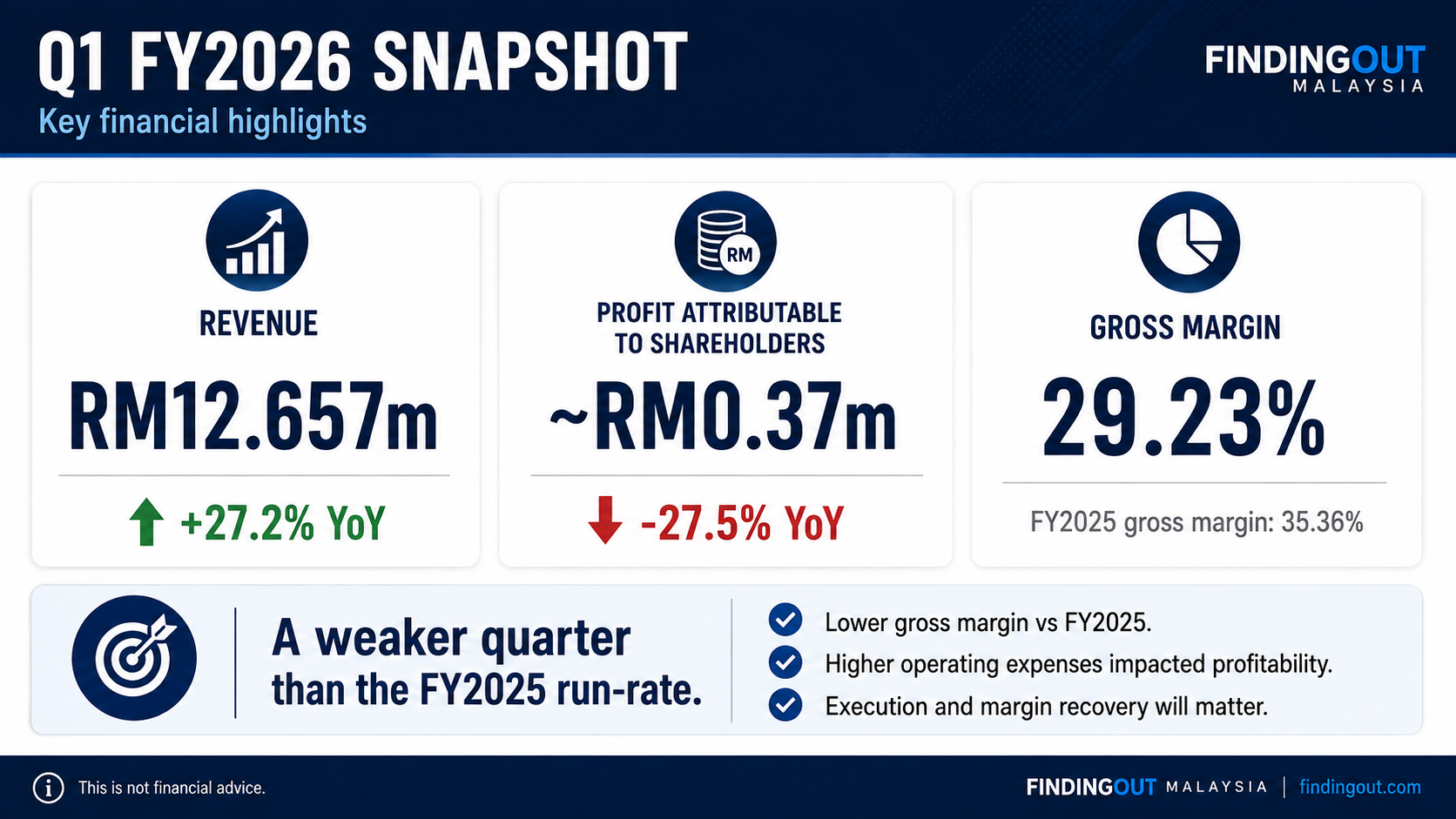
    RT Pastry Q1 FY2026 financial snapshot showing RM12.657 million revenue, approximately RM0.37 million attributable profit and 29.23% gross margin.

    RT Pastry Q1 FY2026 Financial Snapshot

    Management later said the lower first-quarter net profit margin was mainly affected by a higher effective tax rate from non-deductible expenses rather than weaker core operations. Even so, I want the next few quarters to show that margins and earnings can improve – not simply assume a low historical P/E makes the shares a bargain. [4]

    5. The three angles fit together

    This is where the story becomes more interesting to me. The three observations are not separate.

    RT Pastry already has a visible physical customer base and almost all current sales still come through stores.

    Both central manufacturing plants now have halal certification, which may help broaden consumer and commercial reach.

    The digital channel is so small that online distribution remains an under-developed route to reach more customers.
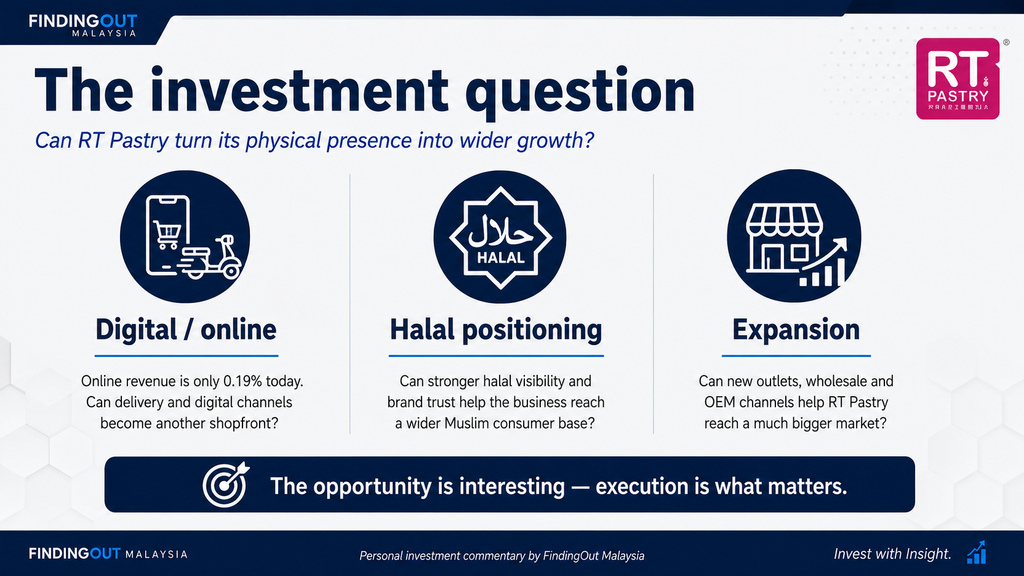
    RT Pastry investment question highlighting digital sales, halal positioning and physical expansion as three areas to watch.

    RT Pastry Investment Question

    Put differently, the opportunity I am watching is not simply “open more bakeries”. It is whether RT Pastry can take an existing product range and brand, broaden its addressable customer base, and distribute those products through more channels.

    Management has set a target of at least 10% annual sales growth while expanding beyond the Klang Valley and strengthening wholesale and OEM business. The IPO plan also allocated proceeds to six new outlets – four in the Klang Valley and two in Pahang. Those are company targets and plans, not my forecasts. [2] [4]

    What would strengthen the thesis?

    • Online revenue becomes meaningful without destroying margin.
    • New outlets expand reach while existing outlets remain productive.
    • Wholesale and OEM become material contributors rather than side businesses.
    • Halal positioning translates into broader consumer or commercial demand.
    • Gross margin and cash generation improve as the post-IPO business scales.

    The opportunity is interesting. Execution is what matters.

    6. My personal plan: Q2, Q3 and the November Shariah review

    I already own RT Pastry shares, so I have money at risk in this thesis. My approach is not to make the immediate post-IPO quarter the decisive test.

    Q2 FY2026 covers April to June, and RT Pastry listed on 29 June – right at the end of that quarter. The IPO prospectus budgeted about RM4.13 million for listing expenses, although different costs can receive different accounting treatment and I would not assume the whole amount runs through one quarter’s profit-and-loss account. For that reason, I will read Q2 but I do not want to overreact to one headline number. [2]

    The more important earnings checkpoint for me is Q3 FY2026, covering July to September. It is the first full quarter after listing and should provide a cleaner view of the underlying retail business, gross margin, digital contribution and early post-IPO execution.

    The other key date is 27 November 2026, when the next scheduled SC Shariah-compliant securities list is due. This is an SC Shariah Advisory Council process, not a Bursa Malaysia decision. I am not assuming RT Pastry will be reclassified. I simply see the date as another piece of evidence. [7] [8]
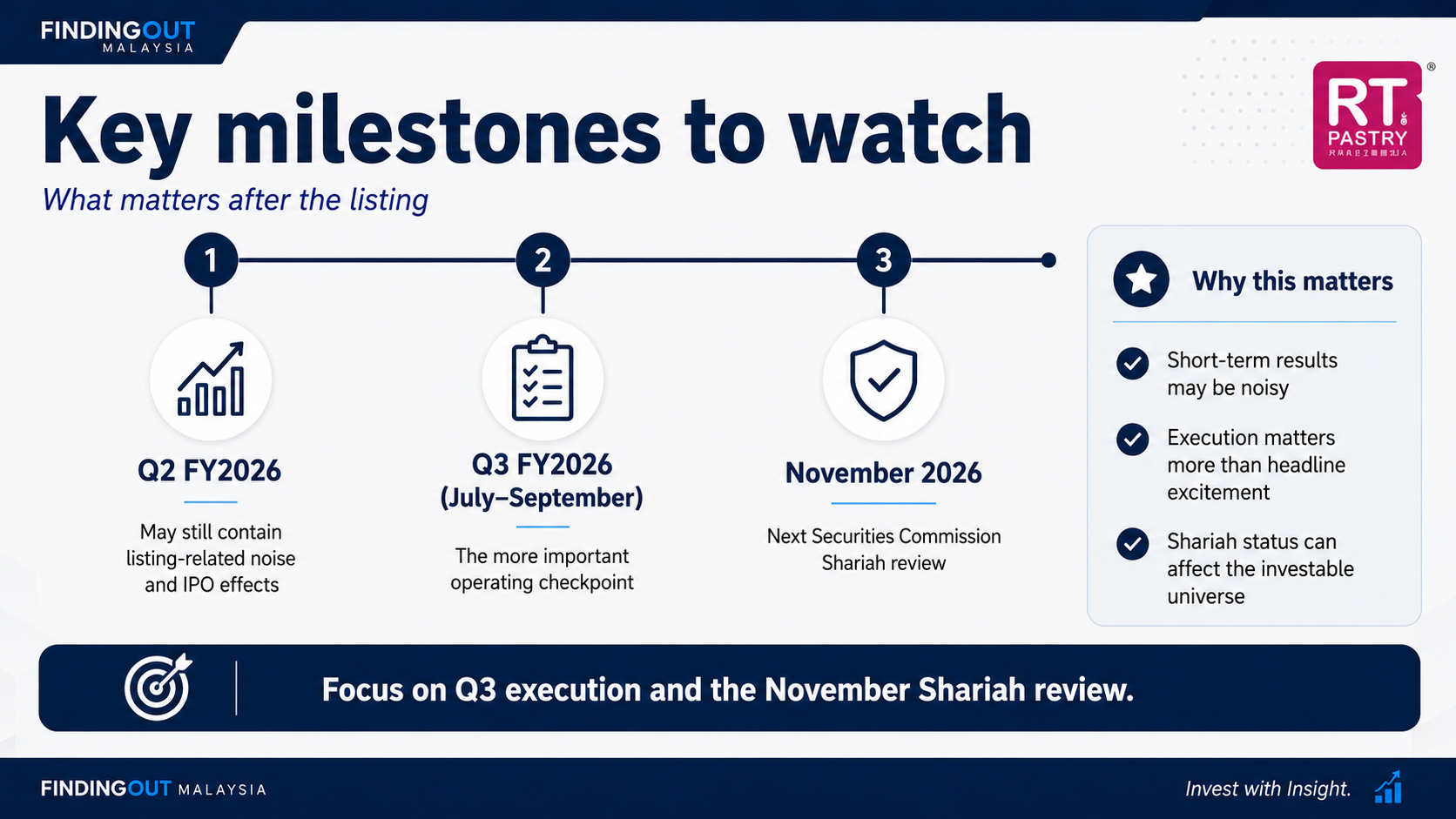
    RT Pastry key investment milestones covering Q2 FY2026, Q3 FY2026 and the November 2026 Shariah status review.

    RT Pastry Key Milestones to Watch

    What I will be watching

    • Quarterly revenue and same-store/retail momentum.
    • Gross margin recovery from the 29.23% Q1 level.
    • Online sales from the current 0.19% base.
    • Wholesale and OEM contribution.
    • New-outlet execution and Pahang expansion.
    • Cash generation and whether growth converts into earnings.
    • The November Shariah classification update.

    My position for now: watch Q2, place greater weight on Q3, then reassess the business and the November Shariah checkpoint with fresh evidence.

    My position for now

    For me, the question is no longer whether RT Pastry simply returns to its 18 sen IPO price. I do not treat 18 sen as a target. The better question is whether the company can use its capital, halal platform, physical network and new distribution options to become a broader and more profitable bakery business.

    That means I will be watching three things above all: whether online channels become meaningful, whether the halal/Shariah story develops in a way that broadens the customer and investor base, and whether the real-world customer demand I have observed translates into stronger business performance.

    The opportunities are interesting. Execution is what matters.

    More from FindingOut

    Website: findingout.com
    YouTube: youtube.com/@findingout-Malaysia

    Personal views. Malaysian companies. My own research.

    Disclosure and Important Notice

    I currently hold shares in RT Pastry Holdings Berhad and therefore have a financial interest in the company discussed in this article. My ownership may influence my interpretation of the company, and readers should take that potential bias into account.

    I am not a financial adviser, securities analyst, stockbroker, investment professional or licensed investment adviser. I do not claim to be an expert or to hold any professional qualification in investment analysis. This article records my personal observations, research and interpretation of publicly available information.

    Nothing in this article constitutes personalised investment advice, a research recommendation, an offer or a solicitation to buy, sell or hold any security. Share prices can rise or fall substantially and investors may lose part or all of their investment. Readers should conduct their own research and, where appropriate, obtain advice from a properly licensed professional.

    Data note: 13.5 sen is the closing-price reference used for this commentary from 24 August 2026. It is not a live price. Delivery-platform availability can vary by outlet and location, and Shariah classification is time-sensitive. These points should always be checked against the latest available information.

    Regulatory note

    The Securities Commission Malaysia has clarified that sharing factual or educational information generally differs from providing investment advice, but recommendations or opinions that may induce someone to buy, sell or hold an investment can fall within regulated investment-advice activity depending on the circumstances. A disclaimer alone does not determine the regulatory position. This article is intentionally framed as disclosure of my own observations and decision-making rather than personalised advice to readers. [10]

    Sources and Reference Notes

    1. RT Pastry official website / Investor Relations – Open source – current 18-outlet footprint, 500+ products, online shop and corporate overview.
    2. RT Pastry IPO Prospectus / prospectus launch – Open source – 18-sen IPO, listing date, proceeds, audited FY2022-FY2025 financials, enlarged share base and adjusted FY2025 earnings.
    3. The Edge Malaysia – ACE Market-bound RT Pastry posts RM0.37m net profit for 1Q – Open source – Q1 FY2026 revenue, retail contribution, gross margin and attributable profit.
    4. The Edge Malaysia – RT Pastry targets 10% annual sales growth – Open source – management growth target, wholesale/OEM plans and domestic expansion.
    5. The Star – RT Pastry secures JAKIM halal certification for manufacturing facility – Open source – Plant 1 certification effective 1 July 2026, valid to 30 June 2028.
    6. Utusan Malaysia – RT Pastry sasar ruang pasaran baharu dengan sijil halal – Open source – Plant 2 certified since 2023 and commercial halal strategy.
    7. Securities Commission Malaysia – Shariah status for companies seeking listing – Open source – RT Pastry pre-listing status: Non-Compliant, updated 11 June 2026.
    8. Securities Commission Malaysia – Shariah-compliant securities and screening methodology – Open source – May/November update cycle and business/financial screening framework.
    9. The Star MarketWatch – RT Pastry Holdings Berhad (RT, 0461) – Open source – 13.5-sen closing price on 24 August 2026.
    10. Securities Commission Malaysia – Guidance Note on Provision of Investment Advice – Open source – guidance on factual/educational content versus investment advice.
    11. Author’s personal observations – Personal source – visits to RT Pastry outlets in Taman Segar and Taman Desa; anecdotal observations only, not independently measured footfall data.

    Editorial notes

    The Q1 FY2026 figures are from RT Pastry’s maiden quarterly report; no year-on-year comparison was available in that report.

    The 7.6x and 8.7x P/E figures are simple backward-looking calculations at 13.5 sen and are not target prices.

    The November Shariah review is a checkpoint, not a prediction of reclassification.

    Any future website update should refresh the share price, outlet count, delivery availability and Shariah status before republishing.
  • Astro at 6 Sen: The Netflix Clue That Made Me Look Again

    Astro at 6 Sen: The Netflix Clue That Made Me Look Again

    Disclosure: I currently own shares in Astro Malaysia Holdings Berhad and therefore have a financial interest in the company. I am not a licensed financial adviser, securities analyst, stockbroker or professional investor. This article records my personal observations and reasoning and is not investment advice or a recommendation to buy or sell Astro shares.

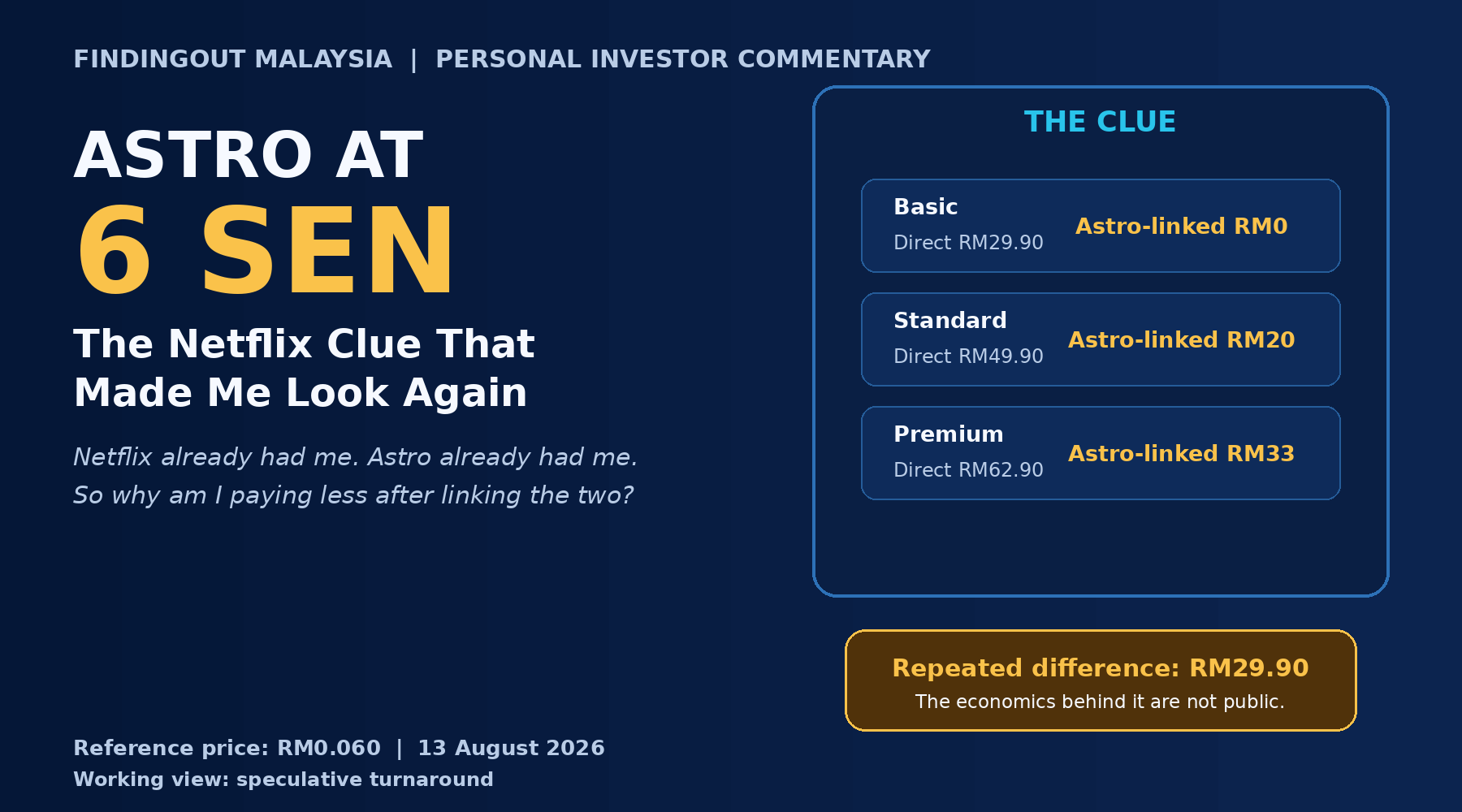
    The starting point: a 6-sen reference price and a repeated RM29.90 difference between direct Netflix pricing and the linked prices shown in my account.

    Sometimes an investment idea begins with an annual report or a stock screener. This one began with an email from Netflix. I have paid Netflix directly since 2018 and I am also an Astro customer. Until recently, I treated the two as completely separate services. Then I was invited to link my existing Netflix account through Astro.

    The price shown after linking the accounts made me stop and think. Netflix already had me as a paying customer. Astro already had me as a customer. Yet the linked arrangement reduced the incremental amount shown to me. That became the clue that made me look again at Astro — not because it proves a turnaround, but because it made me ask what economic value Astro might still have as an aggregator, distributor and long-term customer relationship.

    1. The price difference that caught my attention

    Inside my linked Netflix account, the prices shown were Basic RM0, Standard RM20 and Premium RM33. Compared with the Malaysian Netflix RRPs of RM29.90, RM49.90 and RM62.90 respectively, every tier showed the same effective difference: RM29.90.

    Comparison of direct Netflix Malaysia prices with the lower Astro-linked Netflix prices shown in the author's account.

    Direct Netflix RRP versus the linked prices displayed in the author’s Netflix account. Account eligibility and package terms may differ between customers.

    That repeated RM29.90 is the clue. It is not proof that Astro itself is paying the difference, nor does it tell us how Netflix and Astro divide the economics. Their commercial terms are not publicly disclosed.

    Astro’s public Netflix add-on page separately advertises discounted Netflix add-ons for eligible customers on a 24-month contract. That public pricing is not the same as the linked-account pricing above, but it supports the broader idea that Astro is using Netflix as part of a longer customer proposition rather than simply reselling one month of streaming. [5]

    What could explain the economics?

    • Wholesale or bundled pricing: Astro may receive Netflix at a negotiated bundle cost.
    • Revenue sharing: Astro may retain part of subscriber value when customers sign up through its platform.
    • Lower churn: a stronger bundle may make households more likely to remain in the Astro ecosystem.
    • Upselling: Netflix may help Astro cross-sell Sooka, broadband, sports, advertising or other services.

    The point is not to guess the confidential contract. The point is that a lower monthly price can still make commercial sense if it creates a longer and more valuable customer relationship.

    2. The 24-month angle — and what Astro is trying to become

    The 24-month term matters because a direct Netflix subscriber can cancel next month, while a subscriber embedded inside a broader Astro relationship may stay longer. The relevant economics may therefore be less about one month’s price and more about lifetime value, retention and the ability to monetise the same household across several services.

    Illustration of Astro's transition from traditional pay TV towards a broader streaming, entertainment and content ecosystem.

    The strategic transition I am watching: from a traditional satellite pay-TV model toward a broader entertainment, streaming and content ecosystem.

    My question is not whether Astro can become the old Astro again. It is whether the newer ecosystem can stabilise customers, revenue and cash generation from today’s much lower base.

    I took up the Netflix offer myself, and several friends I know have also taken it up. That is anecdotal rather than market evidence, but it raises a useful scale question: could the linked proposition become meaningful if enough Malaysian Netflix users move through Astro?

    A simple scale illustration — not a forecast

    Netflix does not publish a Malaysia-specific subscriber count. The article uses a third-party FlixPatrol estimate of approximately 2.44 million subscriptions in Malaysia for 2025. Using that only as a working base, the following scenarios show the potential gross-billing scale if 10%, 20% or 30% of that base were linked through Astro at an illustrative RM20 per month. [8]

    Illustrative take-upLinked subscribersAnnual gross billings @ RM20 / monthEquivalent to FY26 revenue
    10%243,750RM58.5m2.1%
    20%487,500RM117.0m4.2%
    30%731,250RM175.5m6.3%

    llustrative gross-billing sensitivity only. Depending on contract and accounting treatment, Astro could recognise the full amount, a net commission or another amount entirely.

    3. Top line more plausible; bottom line still uncertain

    If take-up grows, I would expect some positive economic effect somewhere — through billings, subscription revenue, retention, lower churn, advertising, rebundling or related monetisation. I am much less confident about predicting the bottom line because the commercial split, subsidies and accounting treatment between Netflix and Astro are not public.

    Illustration of why Astro's potential revenue improvement is easier to assess than its eventual profit recovery.

    Why the top-line thesis is easier to frame than the bottom-line thesis.

    Why the market is so pessimistic

    The Netflix clue only matters because Astro is already priced for a very difficult future. Revenue fell from RM5.613 billion in FY17 to approximately RM2.790 billion in FY26. PATAMI peaked at RM771 million in FY18 and was only RM63 million in FY26. The share price moved from around RM2.65 at the end of 2017 to 6 sen on 13 August 2026. This is a structural reset, not a one-quarter problem. [1] [2] [3]

    4. What does 6 sen actually mean?

    A low share price is not the same thing as a low-risk investment. Six sen can still become three sen, one sen or zero. What interests me is the asymmetry if the business merely stabilises from a very depressed base.

    Astro Malaysia valuation snapshot at a reference share price of 6 sen, including market capitalisation and valuation context.

    Reference valuation snapshot at 6 sen. The implied FY26 P/E and price/sales ratios are simple calculations, not live broker multiples.

    At the 6-sen reference price, the approximate market capitalisation is around RM314 million. Against FY26 PATAMI of RM63 million, that implies a simple backward-looking earnings multiple of about 5.0 times. But that number should not be read in isolation. Q1 FY27 PATAMI was only RM2 million, earnings remain volatile and net debt-to-EBITDA stood at 3.0 times. Astro’s official dividend history also shows no dividend after 1QFY24. [4] [9]

    The latest quarter is still weak — but there are useful operating signals

    Q1 FY27 revenue was RM660 million, PATAMI RM2 million, free cash flow RM100 million and cash and bank balances RM491 million. Pay-TV ARPU was RM93.90. Sooka’s VIP paying subscriber base grew 29% year on year. [4]

    Astro Q1 FY27 operating and financial metrics, including revenue, PATAMI, free cash flow, cash balance, pay-TV ARPU and Sooka subscriber growth.

    Selected Q1 FY27 operating and financial metrics from Astro’s results presentation and release.

    5. More than billing: Astro also brings content and reach

    Astro describes itself as Malaysia’s largest content creator. In FY26 it produced 11,600 hours of content and offered around 80,000 On Demand videos. In Q1 FY27, six Astro-produced shows appeared in Netflix Malaysia’s Top 10. That tells me the relationship can involve content as well as billing and distribution. [1] [4]

    Astro content and distribution ecosystem showing how its relationship with Netflix can extend beyond billing into local content, distribution and audience reach.

    Content and distribution can be another layer of the Astro-Netflix relationship beyond billing.

    Could Netflix ever invest in Astro? It is possible in theory, but there is no public evidence today that such an investment is being planned. I would not base an investment thesis on that speculation. Deeper licensing, regional distribution or co-production are more modest possibilities that can exist without an equity transaction.

    What would have to go right — and what could still go wrong

    Astro turnaround scenario showing the key factors that could support recovery and the risks that could still weaken the investment case.

    The turnaround case is testable: customer trends, streaming monetisation, cash flow and leverage should eventually show whether the thesis is strengthening or weakening.

    6. My personal plan: the next two reporting cycles

    I have already bought Astro shares, so I have money at risk in this thesis. My initial plan is to watch the next two reporting cycles over roughly four to six months. This is my personal decision, not a recommendation for anyone else.

    Astro’s Q2 FY27 ended on 31 July 2026. I will read those results, but I do not expect that quarter alone to settle the question because the newer Netflix promotions may not yet have had enough time to work through customer behaviour. The quarter I am more interested in is Q3 FY27, ending 31 October 2026. By then there should have been more time for take-up, retention effects and any revenue contribution to become visible.

    Astro monitoring timeline highlighting the next reporting cycles and key operating indicators to watch for evidence of stabilisation.

    My initial observation period: review Q2 FY27, place greater weight on Q3 FY27, then reassess.

    What I will be watching

    • Whether quarterly revenue begins to stabilise after years of decline.
    • Whether customer numbers, churn or retention show improvement.
    • Whether ARPU stabilises despite lower-priced bundles.
    • Whether management indicates that streaming partnerships are becoming financially material.
    • Whether Sooka continues to grow paid subscribers and engagement.
    • Whether free cash flow remains healthy and leverage remains manageable.
    FindingOut view of Astro as a speculative turnaround to be tested against future results rather than an established recovery.

    My position for now: a speculative turnaround worth testing against the next results, not a conclusion that the turnaround has already happened.

    My conclusion

    Netflix already had me. Astro already had me. Yet the two companies found a way to make the linked Netflix proposition materially cheaper for me. That does not prove that Astro is undervalued, and it certainly does not tell us how profitable the Netflix arrangement is.

    What it does tell me is that Astro still has something that may be economically useful: a customer relationship, billing platform, distribution reach, local content and a growing set of streaming and digital touchpoints. The old pay-TV business has declined dramatically. The question is whether those remaining assets can be reorganised into a smaller but more durable ecosystem.

    At 6 sen, I think that question is interesting enough to watch with my own money. But I do not want to become emotionally attached to it. After the next results — especially Q3 FY27 — I will reassess. Depending on what the evidence shows, I may continue holding, add, reduce or exit. If the evidence changes, the thesis should change.

    Disclosure and Important Notice

    I currently hold shares in Astro Malaysia Holdings Berhad and therefore have a financial interest in the company discussed in this article. My ownership may influence my interpretation of the company, and readers should take that potential bias into account.

    I am not a financial adviser, securities analyst, stockbroker, investment professional or licensed investment adviser. I do not claim to be an expert or to hold any professional qualification in investment analysis. This article records my personal observations and reasoning after studying publicly available information.

    Nothing in this article constitutes personalised investment advice, a research recommendation, an offer or a solicitation to buy, sell or hold any security. Investing in shares can result in substantial or complete loss of capital. Readers should conduct their own research and, where appropriate, obtain advice from a properly licensed professional.

    The Netflix-Astro commercial terms are not publicly disclosed. The Malaysia Netflix subscriber figure used in the sensitivity analysis is a third-party estimate, not an official Netflix disclosure. The gross-billing illustrations are scenarios only and are not forecasts of Astro revenue or profit. There is no public evidence that Netflix plans to invest in Astro Malaysia Holdings Berhad.

    Regulatory note

    The Securities Commission Malaysia has clarified that providing investment advice is a regulated activity and that certain financial insights or recommendations shared through social media can cross into regulated activity. A disclaimer alone does not determine whether content is regulated. This article is intentionally framed as personal observation and disclosure of my own decision rather than personalised advice to readers. [12]

    Sources and Reference Notes

    1. Astro Integrated Annual Report 2026 — FY26 revenue RM2.8bn, PATAMI RM63m, FCF RM459m, 5.2m TV households, 11,600 content hours and 80,000 On Demand videos. Open source
    2. Astro Integrated Annual Report 2025 — historical group financial review for FY21-FY25. Open source
    3. Astro Integrated Annual Report 2021 — historical group financial review for FY17-FY21. Open source
    4. Astro Q1 FY27 release / presentation — revenue RM660m, PATAMI RM2m, FCF RM100m, ARPU RM93.90, cash RM491m, net debt/EBITDA 3.0x, Sooka VIP +29% YoY, and six Astro-produced Netflix Malaysia Top 10 titles. Open source
    5. Astro Netflix add-on page — current public add-on pricing and 24-month contract terms. Open source
    6. Astro and Netflix strategic partnership — original 2021 announcement. Open source
    7. Netflix partner strategy — statement that Netflix had commercial relationships with more than 160 telco/ISP partners globally. Open source
    8. FlixPatrol — third-party 2025 estimate of 2,437,500 Netflix subscriptions in Malaysia. Open source
    9. Astro official dividend history — latest listed distribution is 1QFY24. Open source
    10. Investing.com historical data — reference close of RM0.060 on 13 August 2026. Open source
    11. Author’s Netflix account — linked pricing displayed in August 2026: Basic RM0; Standard RM20; Premium RM33. This is account-specific and not a general public price claim.
    12. Securities Commission Malaysia — guidance on investment advice and finfluencers. Open source

    Share-price chart note: selected historical nominal observations are used for visual context; they are not a continuous total-return series. Valuation snapshot calculations are simple reference-price calculations, not live broker estimates.