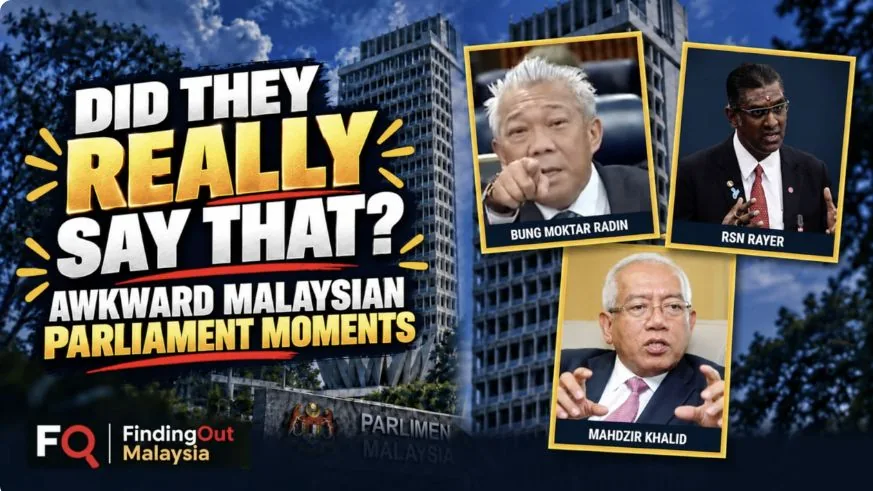
Two exchanges. A few unforgettable words. And a debate that suddenly became about the language itself.
FindingOut Malaysia revisits two awkward moments from the Dewan Rakyat in 2018: Bung Moktar Radin’s F-word exchange and later withdrawal, and RSN Rayer’s “kepala bapak” remark and Mahdzir Khalid’s objection. The compilation combines original parliamentary recordings with narration, subtitles and a little language context.
These are separate historical events, presented by topic rather than in date order. The dates, constituencies and roles below refer to the time of the recordings.
Content note: The videos contain strong language and discussion of expressions some viewers may find offensive.
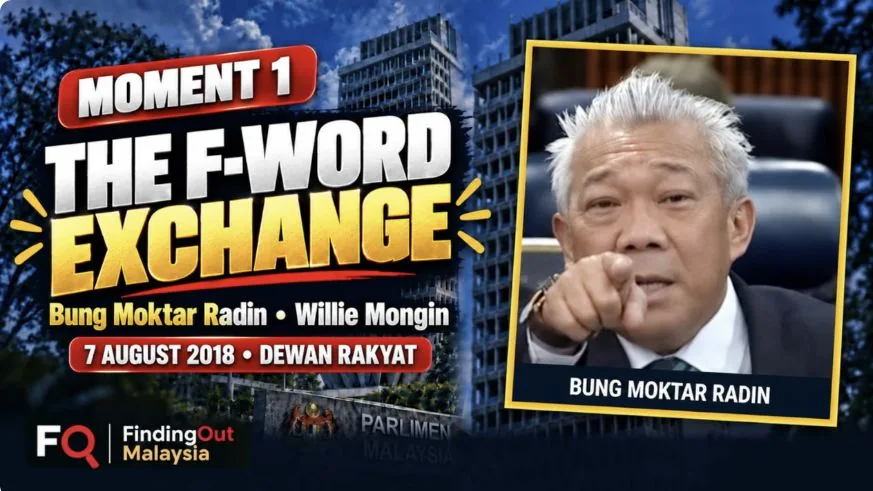
Moment 1 — Bung Moktar: The F-Word Exchange
7 August 2018 · Dewan Rakyat
Bung Moktar Radin, then the MP for Kinabatangan, was discussing prices and a visit to Selayang’s wholesale market when Willie Mongin, the MP for Puncak Borneo, interrupted with a question referring to a casino. The exchange became heated, and Bung’s use of the F-word prompted objections from other MPs. The official parliamentary record for 7 August 2018 preserves the wider debate and the ensuing exchanges.
What happened later? The video also includes the withdrawal discussion from later that afternoon. Bung withdrew the remark and acknowledged that the language was impolite, as FMT reported that day. The “Later That Day” card matters: the withdrawal did not immediately follow the first outburst.
A note on Bung Moktar: Bung Moktar Radin passed away on 5 December 2025, aged 66, in Kota Kinabalu, as reported by Bernama. The parliamentary footage featured here dates from 2018.
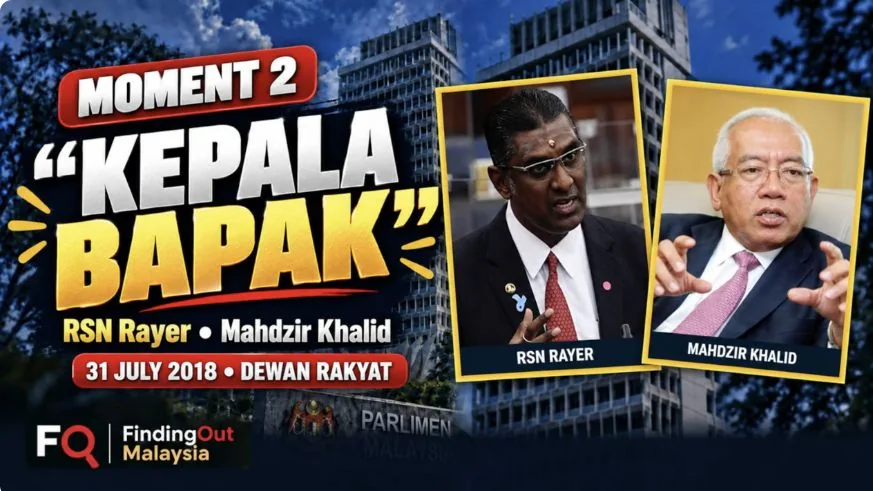
Moment 2 — RSN Rayer and Mahdzir Khalid: “Kepala Bapak”
31 July 2018 · Dewan Rakyat
A week earlier, RSN Rayer, the MP for Jelutong, was questioning the previous administration’s record on police welfare and facilities. His use of “kepala bapak” drew an immediate objection from Mahdzir Khalid, the MP for Padang Terap, who challenged the language and urged him to use facts in the debate. Malaysiakini’s contemporary account describes the exchange and the calls for the words to be withdrawn.
The selected footage lets viewers hear both Rayer’s remark and Mahdzir’s response. It is a reminder of how quickly a discussion about public services can turn into an argument over what is acceptable to say in Parliament.
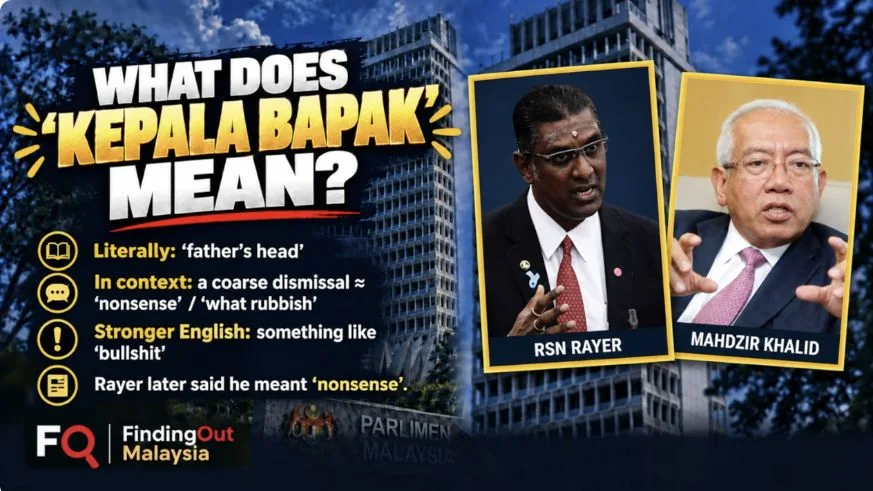
What Does “Kepala Bapak” Mean?
Literally, the Malay words mean “father’s head.” In this exchange, the phrase works as a coarse dismissal, roughly along the lines of “nonsense” or “what rubbish.” The literal translation alone does not convey the tone, and its force depends on context and delivery.
Rayer later said that he meant “nonsense” or “mengarut” and denied intending an insult, according to MalaysiaGazette’s report of 1 August 2018. That was his explanation; Mahdzir’s objection shows that the wording was received differently in the chamber. The English comparisons in the video are approximate explanations, not exact or official translations.
Watch in Malay, Tamil or Mandarin
There are four versions of this compilation. The English video is at the top of the page; the Malay, Tamil and Mandarin versions are below. Each provides narration and presentation in the selected language while retaining the original speech in the parliamentary excerpts.
The archival parliamentary excerpts are credited to FMT / Free Malaysia Today, carrying RTM / Parliament broadcast credits, and KiniTV / Malaysiakini. The linked parliamentary record and contemporary reports provide further context. Excerpts have been shortened for presentation; statements and allegations remain attributable to their speakers.
FindingOut Malaysia adds editorial narration, graphics and translations. Narration uses AI-generated voices; the parliamentary speech is the original recorded audio. The graphic cards are editorial composites, not additional documentary footage. Translations are FindingOut’s explanations, not official parliamentary translations.
FindingOut Malaysia is independent. The presentation does not imply endorsement by Parliament, the broadcasters or the people shown. Rights in third-party footage, photographs, music and other material remain with their respective owners. For factual, translation or source-credit corrections, please use our contact page and identify the relevant timestamp.
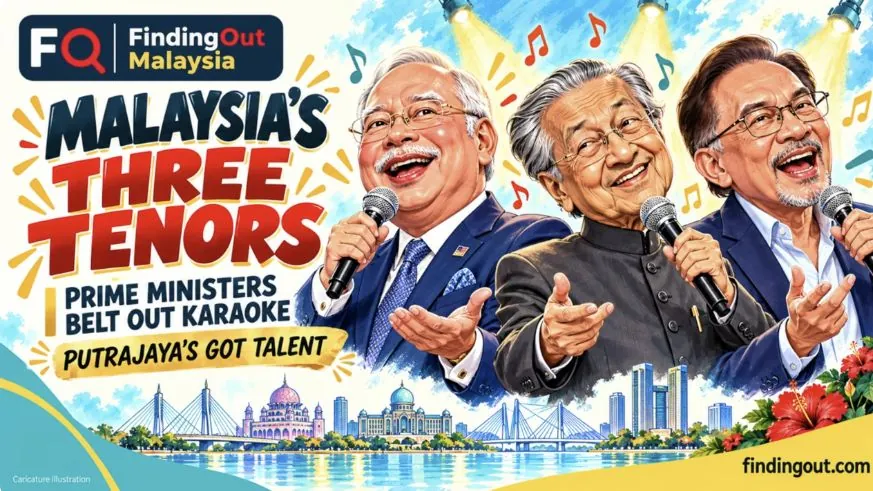
Three Malaysian leaders. Three songs. Three very different styles!
Najib Razak, Dr Mahathir Mohamad and Anwar Ibrahim take the microphone in three memorable musical moments. Enjoy “The Young Ones”, “My Way” and “Sampaikan Salam Cintaku”, with Anwar joined by Alleycats legend David Arumugam.
This light-hearted FindingOut Malaysia compilation brings together performances from different years and events. “Three Prime Ministerial Tenors” is a playful title, rather than a technical classification of their voices. The three leaders were not performing together in a joint concert.
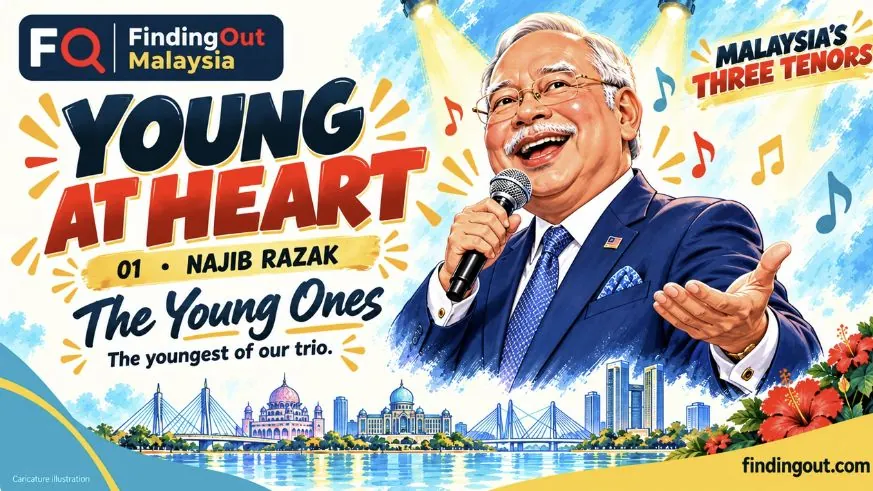
Track 1 — Najib Razak: Young at Heart
“The Young Ones” · Putrajaya · 10 November 2016
First up is Najib, the youngest of our three singers. “The Young Ones” seems a fitting choice: a microphone, a familiar tune and a little musical diplomacy.
The song’s meaning and background: The title points to youth, while the song celebrates love and making the most of the present. Associated with Cliff Richard and The Shadows, it is the title song from the film The Young Ones and a familiar part of their early-1960s repertoire. It was written by Sid Tepper and Roy C. Bennett, as listed in the songwriting credits. The soundtrack also appears in Cliff Richard’s official discography.
The moment in the video: Najib sings at a dinner for Philippine President Rodrigo Duterte at Seri Perdana in Putrajaya on 10 November 2016. The footage is credited to RTVM / Presidential Communications, Philippines, and was published by Rappler as “Duterte, Najib bond over singing at dinner”. A well-known pop tune gives this official occasion a relaxed musical interlude.
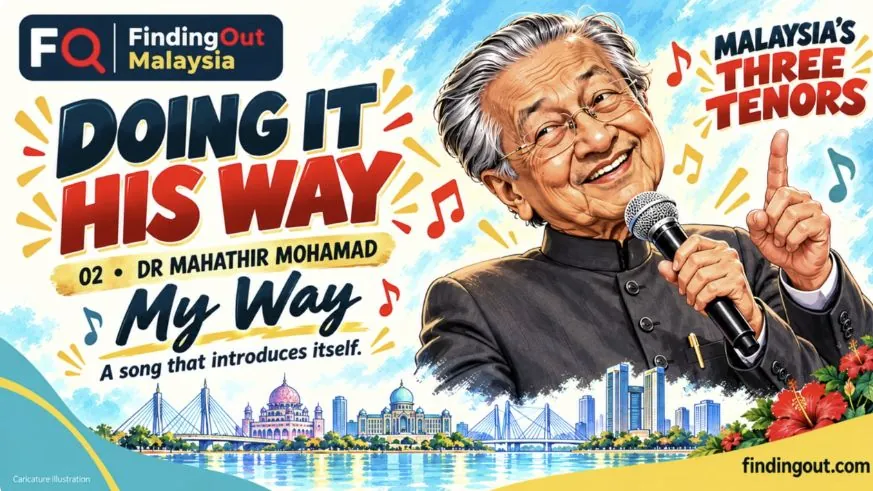
“My Way” · Malam SAHOCA, Kuala Lumpur · September 2015
Next, Dr Mahathir. His choice of song needs no introduction. Whatever you think of his politics, he certainly did things his way. Sing it, Tun!
The song’s meaning and history: “My Way” is a retrospective: a singer looks back on life, its choices and its regrets, with a sense of independence. Paul Anka wrote the English lyrics for Frank Sinatra, whose recording was released in 1969. The melody comes from the French song “Comme d’habitude” — “As Usual” — credited to Jacques Revaux, Claude François and Gilles Thibaut. Anka’s English words tell a different story from the French original. Anka’s own account explains how he wrote with Sinatra’s voice and outlook in mind.
The moment in the video: Mahathir performs at Malam SAHOCA in Kuala Lumpur in September 2015. Astro Awani’s contemporary report identifies his choice of “My Way”, notes Siti Nurhaliza’s participation and records that the gathering also celebrated his 90th birthday. SAHOCA is the alumni association of Sultan Abdul Hamid College in Alor Setar. The report links the performance recording used as the source.
“Sampaikan Salam Cintaku” · Shah Alam · January 2019
Finally, Anwar brings a little romance to the microphone. “Sampaikan Salam Cintaku” means “Send my love”, and he is joined by the legendary singer from Alleycats. Quite a musical duo!
The song’s meaning and background: The Malay title can also be rendered more literally as “Convey my loving regards.” It carries an affectionate message to someone missed. The Alleycats recording dates to 1986; the recording credits name Hamdan Atan (A. Ali) as composer, Juwie as lyricist and M. Nasir as arranger. David and Loganathan Arumugam are credited as vocalists on that recording.
The moment in the video: At a PKR gala dinner in Shah Alam in January 2019, David Arumugam invited Anwar to join him in a duet. mStar’s report describes the audience’s applause and notes that Dasya Logan, daughter of the late Loganathan Arumugam, also accompanied the performance. This was before Anwar became prime minister. Footage is credited to The Star / Star TV.
There are four versions of this compilation. The English video is at the top of the page; the Malay, Tamil and Mandarin versions are below. Each uses narration and presentation in the selected language, while the singing excerpts retain their original recorded sound.
Three prime ministers. Three songs. Three different styles. Which performance made you smile the most? Tell us in the comments, like the video, and subscribe to FindingOut Malaysia for more stories with a different tune. Keep the comments friendly — the vote here is about singing!
Sources & Editorial Note
The linked reports, footage and music credits provide the event context and song background. The dates refer to the individual performances; this compilation brings together separate occasions. The short explanations above describe the songs’ themes without reproducing their lyrics.
The narration and illustrated cards were created with AI assistance. The singing excerpts retain the recorded performances; the illustrations are creative artwork, not documentary photographs. No endorsement by the people, artists, broadcasters or organisations shown is implied.
Production, editorial presentation and compilation: FindingOut Malaysia. Rights in third-party footage, songs, performances and recordings remain with their respective owners. The Creative Commons licence above applies to the background track only. Source credits identify the material used and do not imply ownership or permission.
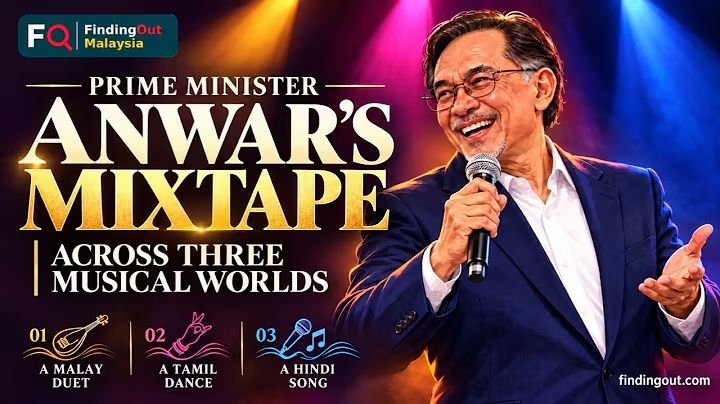
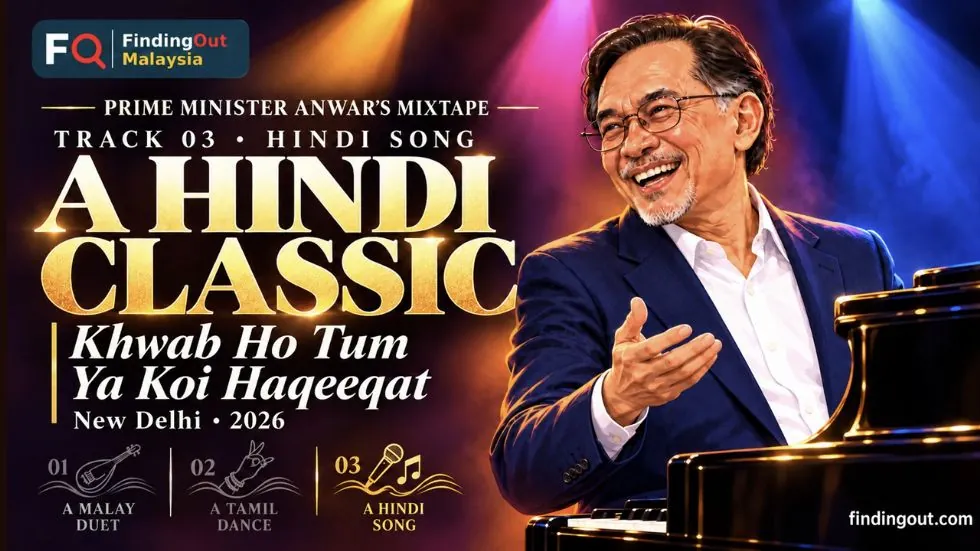
In Prime Minister Anwar’s Mixtape, FindingOut Malaysia brings together three musical moments: Anwar Ibrahim sharing a song with David Arumugam, joining an MGR impersonator’s dance, and singing with piano accompaniment in New Delhi.
Each selection carries its own history, from Malaysian pop to Tamil cinema and classic Hindi film music. Below, we explore what the song titles mean, where the music comes from, and the setting of each performance.
The excerpts come from separate events in different years, including moments before Anwar became Prime Minister. They have been brought together as a musical compilation.
Track 1 — A Malay Duet
“Sampaikan Salam Cintaku” · Shah Alam · January 2019
The meaning: The Malay title can be rendered naturally in English as “Send my love”, or more literally, “Convey my loving regards.” It is an affectionate message to someone missed, giving the song its warm, wistful character.
The song’s background: “Sampaikan Salam Cintaku” was composed by A. Ali (Hamdan Atan), with lyrics by Juwie. It belongs to the Alleycats catalogue and the band’s 1986 Sampaikan Salam album. That places it in the Malaysian pop music of the 1980s, decades before this duet. The album’s recording credits list David and Loganathan Arumugam as vocalists. For listeners who grew up with Alleycats, the melody can bring a strong sense of familiarity and nostalgia.
The moment in the mixtape: David Arumugam invited Anwar to join him at a PKR gala in Shah Alam in January 2019. mStar’s contemporary report describes the duet and the audience’s applause. The appeal here is the shared performance: a familiar singer, a familiar song, and a guest joining in. Footage is credited to The Star / StarTV.
“Naan Aanaiyittal” · Desa Mentari, Petaling Jaya · 2018
The meaning: “Naan Aanaiyittal” means approximately “If I give the order.” Its message is assertive: using authority to challenge wrongdoing and protect ordinary people from hardship. That gives it a very different mood from the gentle longing of the Malay song.
The song’s background: The song comes from the 1965 Tamil film Enga Veettu Pillai, starring M. G. Ramachandran, widely known as MGR. The recorded voice is T. M. Soundararajan, with lyrics by Vaali and music by Viswanathan–Ramamoorthy, as credited by Saregama. MGR performed the song on screen; Soundararajan was the playback singer.
The song became closely associated with MGR’s screen image as a defender of the poor. A retrospective on Vaali recalls its place in the film and its promise of relief from suffering. This background helps explain the commanding poses and energetic gestures that an MGR impersonator brings to the stage.
The moment in the mixtape: In 2018, Anwar joined an MGR impersonator at an Indian cultural night in Desa Mentari. KiniTV’s report describes a cheering, clapping crowd. Anwar is dancing here, and the performer beside him is an impersonator of the late star.
“Khwab Ho Tum Ya Koi Haqeeqat” · New Delhi · September 2026
The meaning: The title asks, approximately, “Are you a dream, or are you real?” It expresses romantic wonder: the feeling that someone is so captivating that their presence seems almost dreamlike. The mood is playful and admiring.
The song’s history: This is a Kishore Kumar song from the 1965 Hindi film Teen Devian, starring Dev Anand. Its music was composed by S. D. Burman, with lyrics by Majrooh Sultanpuri. The film’s archived song booklet records those creative credits, while the soundtrack listing identifies Kishore Kumar’s recording.
The original belongs to the era when playback singers supplied the voices for stars’ on-screen musical performances. Here, Kishore Kumar’s voice is associated with Dev Anand’s screen presence. Knowing that distinction helps place the song within Hindi cinema’s musical tradition. More than sixty years after the film, it is still being revisited in performances such as this one.
The moment in the mixtape: Anwar sings the classic with piano accompaniment during his New Delhi visit in September 2026. Bernama reported that the impromptu rendition, shared on social media during the BRICS summit visit, drew appreciative reactions in India. It brings the compilation to a quieter close after the Tamil dance. The video credits Anwar’s original social-media material and The Star’s video coverage.
The three versions below present the same musical moments in Malay, Tamil and Mandarin. The English version is at the top of this page. Each has narration and presentation in the selected language, while the performances retain their original songs and sound.
A message of love, a bold promise and a moment of romantic wonder: the three songs take us through very different musical moods. Which performance is your favourite? Share your thoughts in the comments below, or suggest another musical moment for a future FindingOut compilation.
Sources & Editorial Note
The linked reports and music catalogues provide the event context and song background. Title meanings above are brief English explanations, rather than full translations of the lyrics. Dates refer separately to the original songs and to Anwar’s performances.
The illustrated cards and narration in the videos were created with AI assistance. The illustrations are creative artwork, not documentary photographs. The performance excerpts retain their recorded sound. English subtitles in the English version cover narration and brief performance labels, rather than translating the complete song lyrics.
Third-party footage, songs and recordings remain subject to their respective rights holders’ rights. FindingOut Malaysia’s contribution is the editorial selection, contextual presentation, narration and graphic design. This independent presentation is for musical interest, commentary and entertainment; no affiliation with or endorsement by the people, organisations or rights holders featured is implied.
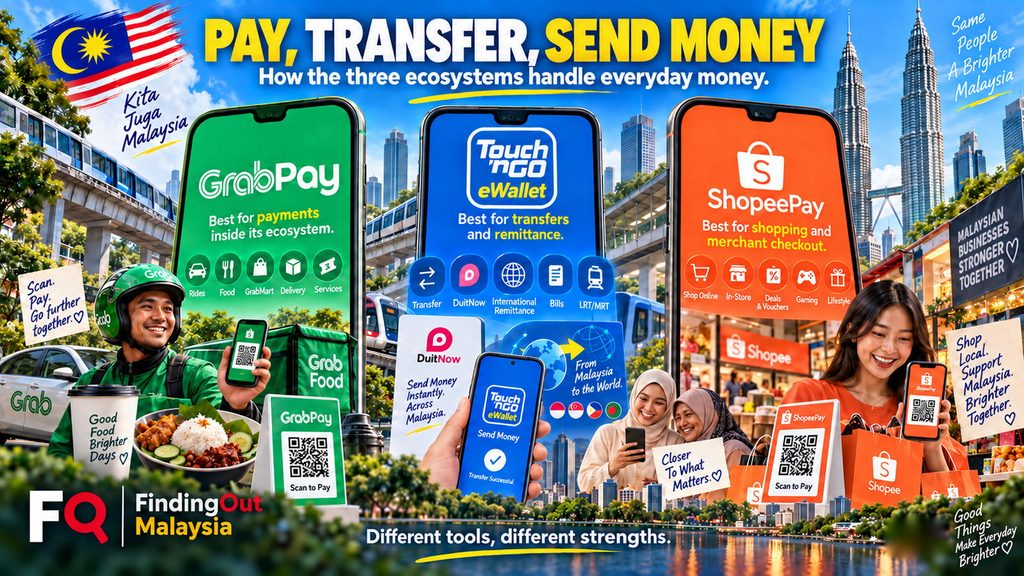
Grab, Touch ’n Go and Shopee started with very different purposes. Today, all three have grown into much broader ecosystems covering transport, food delivery, shopping, payments and financial services.
For many Malaysians, these apps are no longer used for just one thing. So which one is the most useful? The answer depends less on which app has the longest list of features, and more on what you actually need it to do.
Grab: Built Around Movement and Convenience
Grab’s strongest advantage is convenience. For people who move around frequently, Grab brings together ride-hailing, food delivery and everyday delivery services in one familiar app.
You can arrange a ride, order a meal through GrabFood, shop for groceries through GrabMart or use GrabExpress for parcel delivery. GrabPay and PayLater extend the ecosystem into payments, while banking services are connected through GXBank.
In simple terms, Grab is built around moving you — or bringing things to you.
Touch ’n Go: Where Payments Meet Everyday Mobility
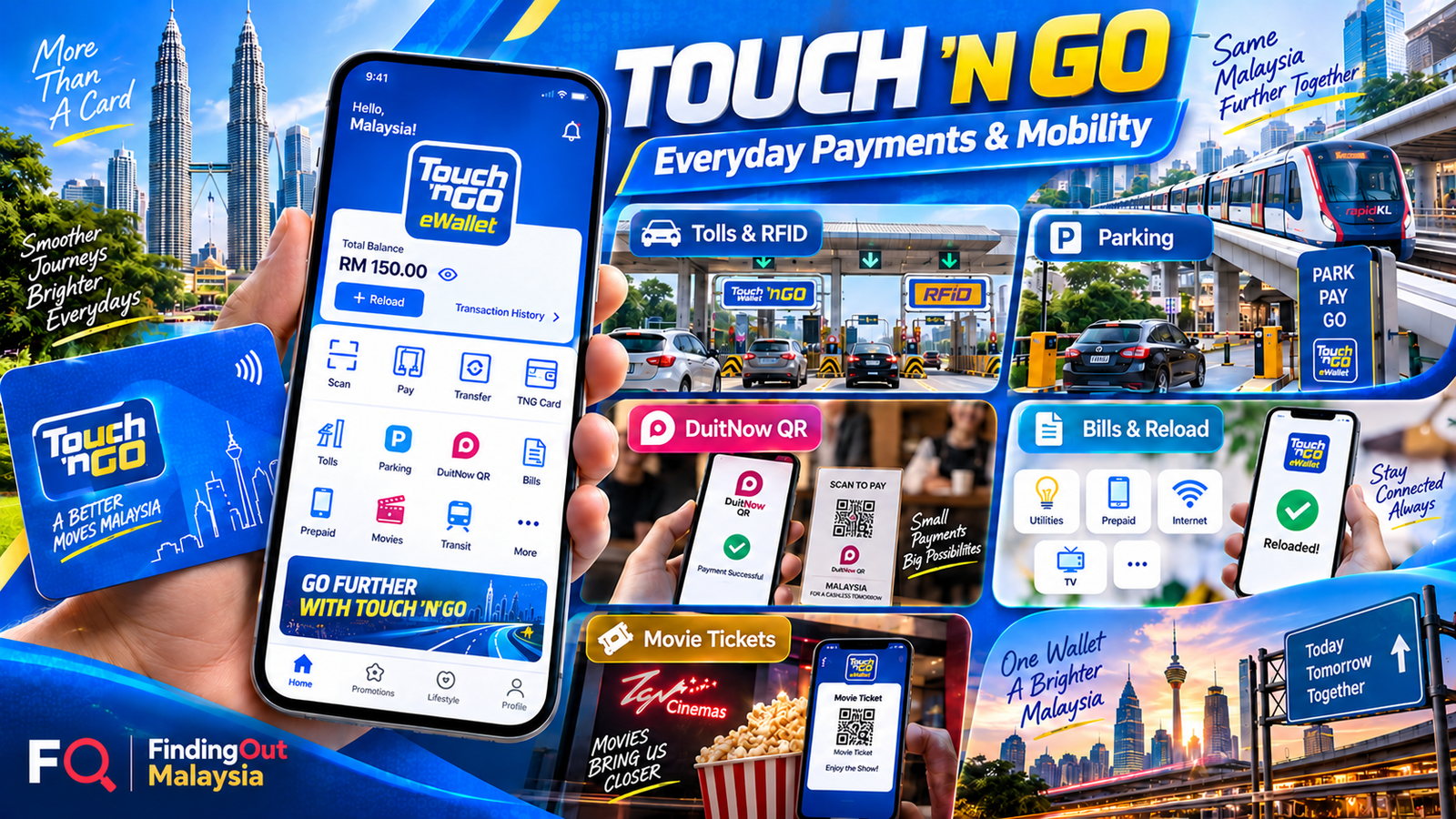
Touch ’n Go occupies a different position in Malaysian daily life. Its roots are closely connected with mobility — particularly tolls and public transport — but the Touch ’n Go eWallet has expanded far beyond the familiar physical card.
Today, the ecosystem covers areas such as toll-related payments, participating parking services, public transport, QR payments, bills and money transfers. Other services extend it further into financial products and selected international transactions.
This gives Touch ’n Go a distinctive strength: it sits at the intersection of everyday mobility and payments.
Shopee: The Marketplace in Your Pocket
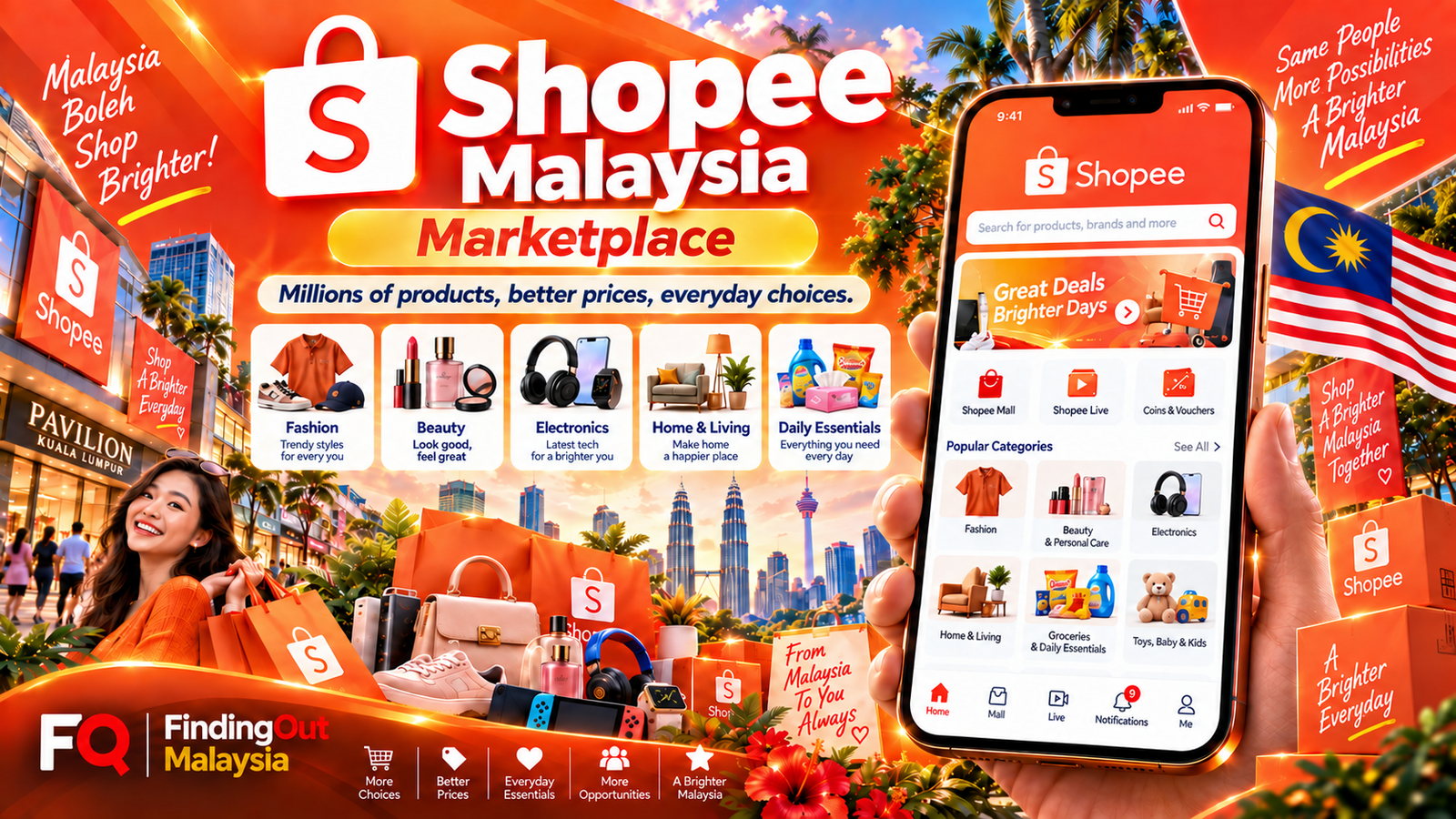
Shopee’s centre of gravity remains shopping. Its biggest strength is the breadth of its marketplace, bringing together large numbers of products, sellers and categories in one app.
But Shopee has also expanded beyond online shopping. ShopeeFood adds restaurant delivery, while ShopeePay and SPayLater extend the ecosystem into payments and financial services.
While Grab is strongest around movement and delivery, and Touch ’n Go around mobility and payments, Shopee’s natural territory remains online shopping and marketplace choice.
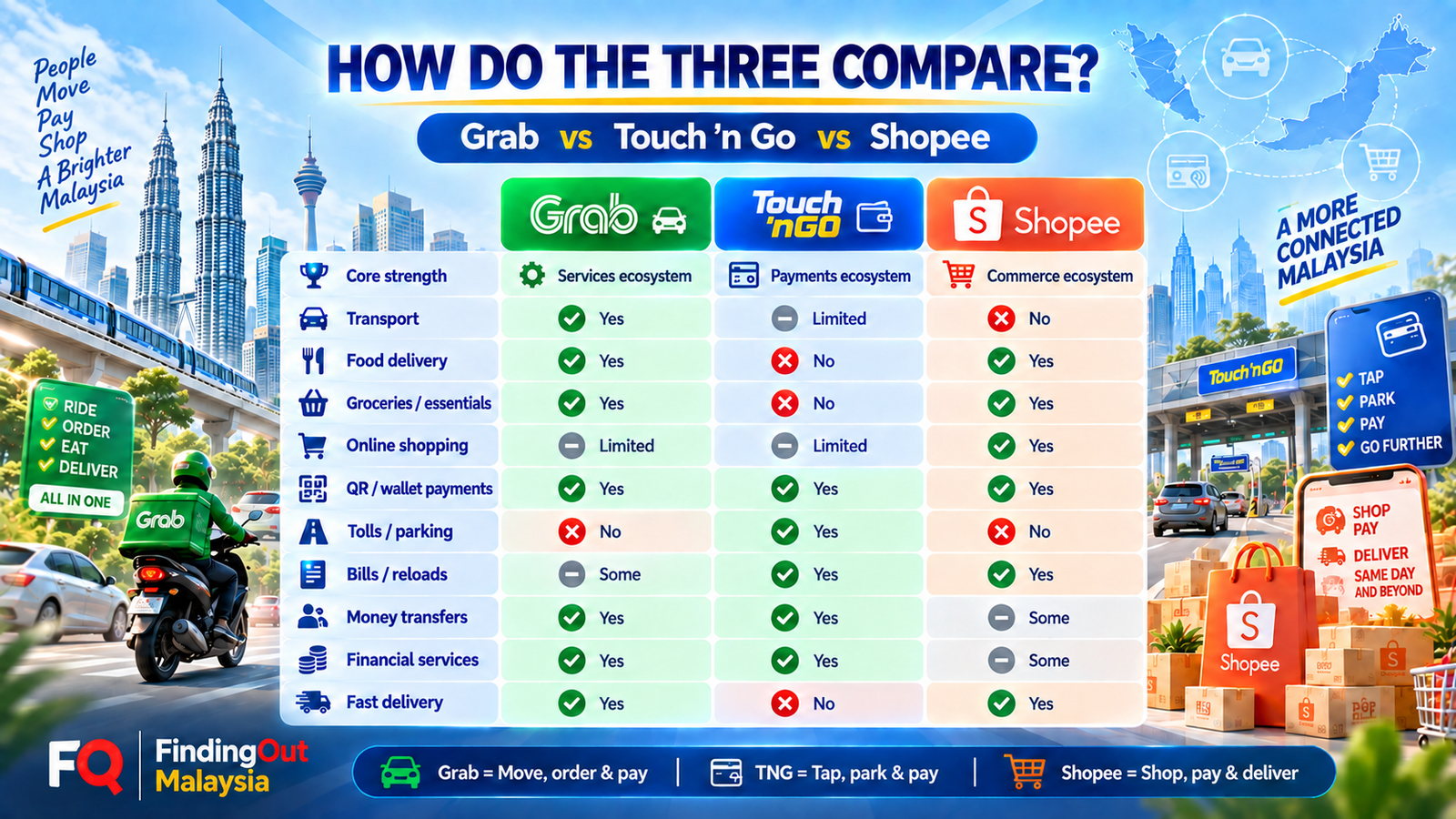
How Do the Three Compare?
All three apps now overlap in several areas, but their core strengths remain quite different. The comparison below shows where each ecosystem is strongest in everyday use.
Payments and Financial Services
Payments are one of the areas where the three ecosystems increasingly overlap. GrabPay supports transactions within the Grab ecosystem, Touch ’n Go eWallet connects payments with everyday mobility and transfers, while ShopeePay is closely tied to shopping and merchant payments.
All three are also expanding into financial services, but their products are not identical. The important point is that each payment system supports the wider ecosystem around it — transport and delivery for Grab, mobility and everyday payments for Touch ’n Go, and commerce for Shopee.
Which One Is Best for You?
There is no single winner for everybody. The most useful super app depends on what you need it to do.
Choose Grab if you frequently move around town, order meals or groceries, or need things delivered. Its strongest advantage is convenience around transport and delivery.
Choose Touch ’n Go if tolls, public transport, parking, QR payments and money transfers are a regular part of your day. Its strength lies where mobility and payments meet.
Choose Shopee if your priority is online shopping — comparing products, sellers and prices, and having purchases delivered. Marketplace choice remains its clearest strength.
Grab moves you and brings things to you. Touch ’n Go connects payments with everyday mobility. Shopee brings the marketplace to your phone.
So the better question is not “Which is Malaysia’s best super app?” — but “Which one is best for you?”
Note: Features, promotions, financial products and service availability can change over time. This article is for general information and comparison only. Readers should check the respective official apps and websites for the latest terms, availability, fees and product information.
Sources & Rights Notice
Information in this article and video was compiled from publicly available sources, including official websites, app pages and published materials from Grab, Touch ’n Go / TNG Digital, Shopee, GXBank and other companies mentioned.
Company names, logos, trademarks, app interfaces, screenshots and other branded material remain the property of their respective owners. They are shown for identification, commentary, comparison and review purposes. FindingOut Malaysia is not affiliated with, sponsored by or endorsed by any of the companies mentioned unless expressly stated.
Features, prices, promotions, financial products and service availability may change over time. Readers should refer to the respective official websites and apps for the latest information.
Third-party images, screenshots, logos and video excerpts remain the property of their respective owners. No ownership of such third-party material is claimed by FindingOut Malaysia.
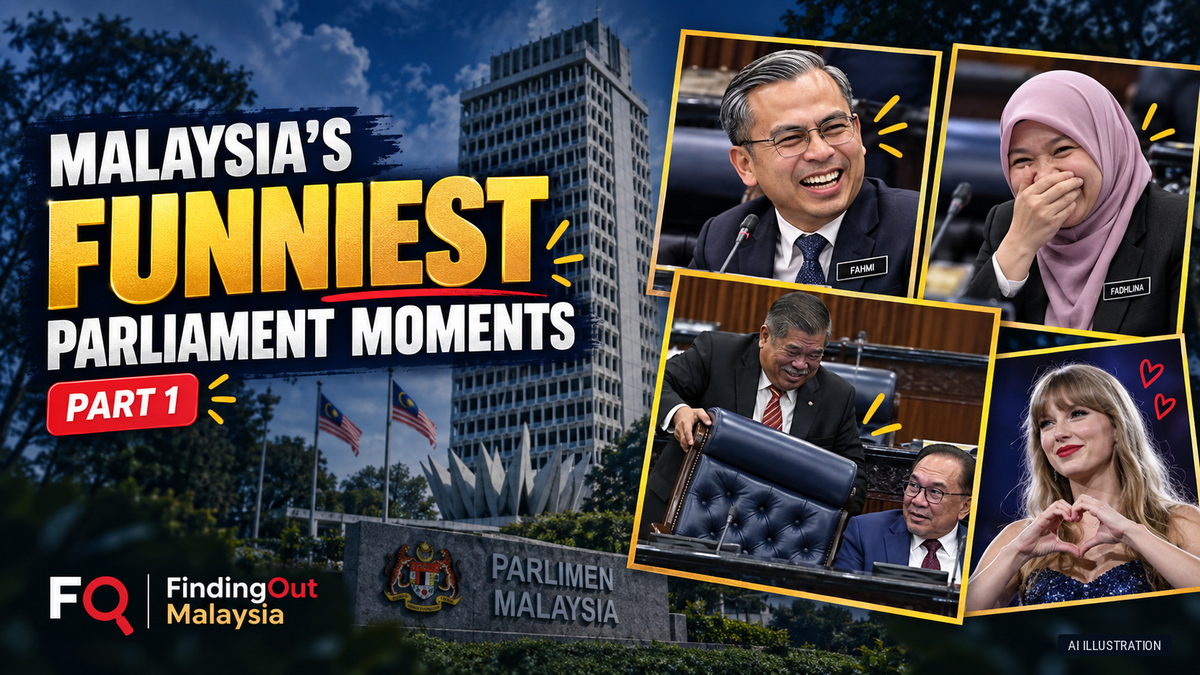
Parliament is serious business — but not every moment goes according to plan.
Malaysia’s Dewan Rakyat has seen its share of heated debates, political arguments and serious policy discussions. Every now and then, however, something completely unexpected happens and the chamber becomes unintentionally funny.
In Part 1 of Malaysia’s Funniest Parliament Moments, FindingOut Malaysia looks back at three lighter moments: a pop-culture misunderstanding involving Taylor Swift, a perfectly timed comeback from the Education Minister, and a piece of quiet visual comedy unfolding behind the Opposition Leader.
Watch the video below, or scroll down for the story behind each moment.
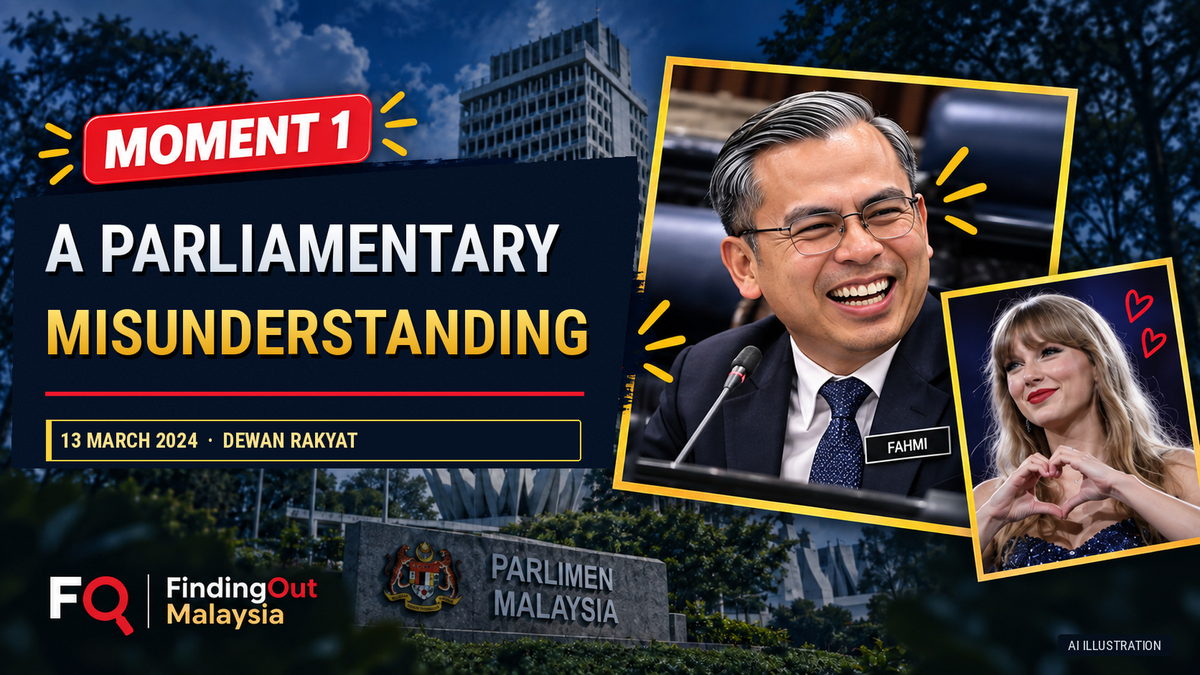
Moment 1 — A Parliamentary Misunderstanding
13 March 2024 · Dewan Rakyat
Communications Minister Fahmi Fadzil was speaking about Taylor Swift and her fans when an otherwise ordinary pop-culture reference suddenly caused confusion in the chamber.
Taylor Swift’s fans are commonly known as “Swifties.” But when Fahmi used the term, Deputy Speaker Ramli Mohd Nor appeared to hear something quite different — turning “Swifties” into something that sounded remarkably like “striptease.”
Fahmi quickly clarified what he meant, repeating the reference to Taylor Swift, while the misunderstanding drew amusement from those in the chamber.
It was a very short exchange, but that was precisely what made it funny: a perfectly innocent word, a momentary misunderstanding, and Parliament briefly trying to keep a straight face.
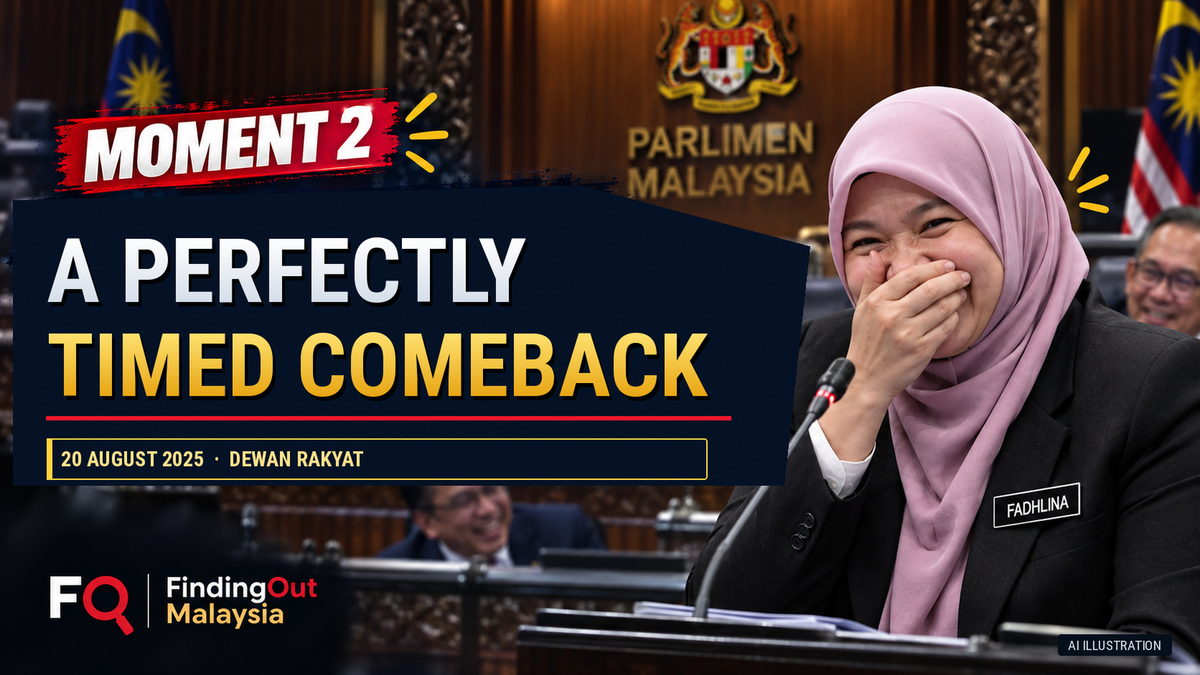
Moment 2 — A Perfectly Timed Comeback
Education Minister Fadhlina Sidek was winding up her ministry’s debate when she was asked to move a little closer to the microphone.
What should have been a routine technical adjustment quickly turned into a light-hearted exchange involving Dewan Rakyat Speaker Johari Abdul.
Fadhlina responded with a line that immediately brought laughter to the chamber:
“Tan Sri Speaker, my husband is watching this live.”
Sometimes parliamentary humour does not need a long argument or an elaborate joke. A quick response delivered at exactly the right moment is enough.
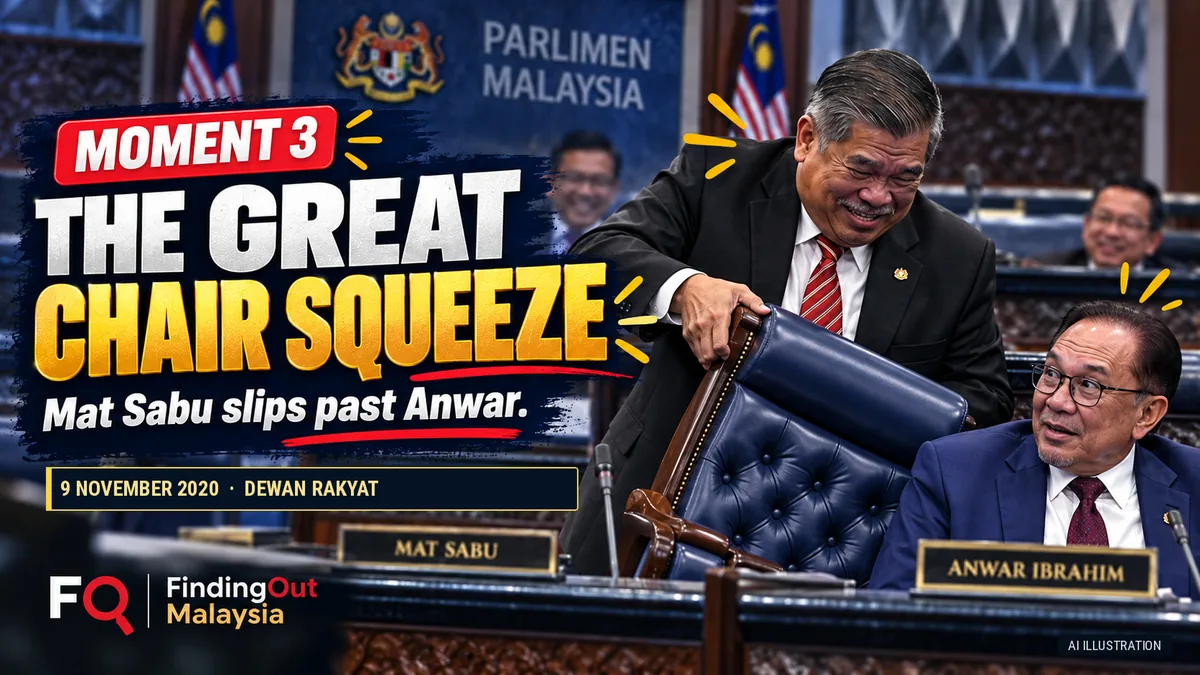
Moment 3 — The Great Chair Squeeze
9 November 2020 · Dewan Rakyat
In 2020, Anwar Ibrahim was Malaysia’s Opposition Leader, while Mohamad Sabu — better known as Mat Sabu — was Amanah president.
As Anwar continued delivering his speech, Mat Sabu attempted to make his way back to his seat behind him. What should have been a straightforward walk past became a small exercise in parliamentary manoeuvring.
The chair had to move. Mat Sabu had to squeeze through the narrow space. Then everything had to be carefully put back into place — all while Anwar continued speaking.
It is classic visual comedy precisely because nobody stops to make a joke about it.
Getting through a debate is one thing. Getting back to your seat is another.
More Parliament moments to come
These are only three of the lighter moments that have taken place in Malaysia’s Parliament.
Some are funny because of what was said. Others are funny because of timing, misunderstanding, or simply what happened in the background while serious business continued around them.
Which moment made you laugh the most?
Watch Malaysia’s Funniest Parliament Moments — Part 1 above, and stay tuned for Part 2 from FindingOut Malaysia.
Sources & Editorial Note
The parliamentary moments featured on this page are based on publicly available recordings and records of Dewan Rakyat proceedings.
Key sources: Moment 1: Parliament of Malaysia — Dewan Rakyat proceedings and Hansard, 13 March 2024. Moment 2: Berita RTM — Parliament afternoon sitting, 20 August 2025; additional close-up footage from The Star. Moment 3: Dewan Rakyat sitting, 9 November 2020; published video reference from World of Buzz.
Source material includes Parliament of Malaysia recordings and Hansard, Berita RTM, The Star, and published footage relating to the respective incidents.
Short excerpts are presented for commentary, review, historical context and public-interest discussion. Copyright in the original third-party footage remains with the respective owners and broadcasters.
The description of these incidents as “funniest” is a subjective editorial opinion and is intended as light-hearted commentary. FindingOut Malaysia does not intend to allege misconduct, illegality or wrongdoing by any person appearing in the material.
Some promotional graphic cards contain AI-generated or digitally created illustrative imagery and should not be interpreted as documentary photographs of the incidents.
Politics is serious business. But sometimes the moments people remember longest are the ones that do not go to script. Here are six Malaysian political moments that became memorable for very different reasons — and the context behind each one.
Watch the Video
Malaysian politics has produced thousands of speeches, press conferences, campaign videos, rallies and interviews. Most are forgotten almost immediately. A handful survive because something about the delivery, timing, reaction or setting turns them into clips people keep replaying.
This is a collection of six such moments. Some are funny because a crowd answered in an unexpected way. Some became awkward because a personal question suddenly became very direct. Others mattered because the subject itself was serious, and the way it was presented drew criticism or required later clarification.
We are not suggesting that these six moments are equivalent, or that they tell you everything about the politicians involved. “Cringe” is an editorial judgment — and a subjective one. Watch the video first, then read the fuller context behind each clip.
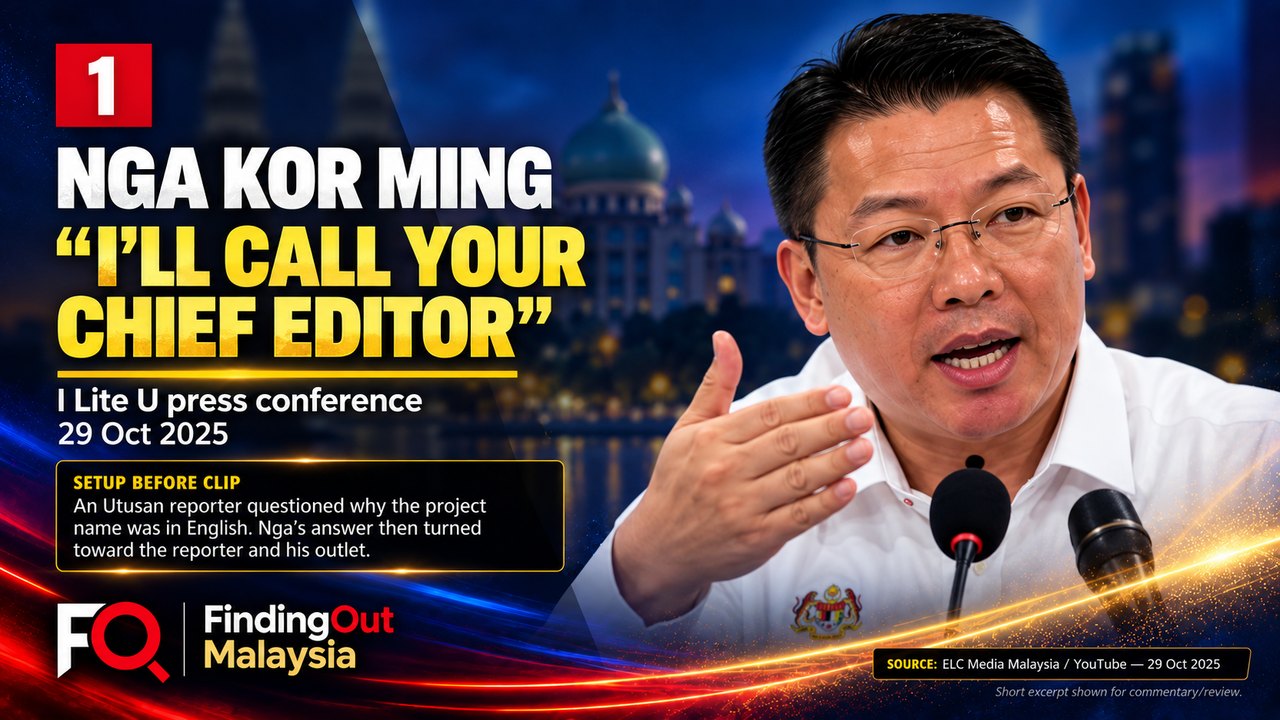
1. Nga Kor Ming — “I’ll Call Your Chief Editor”
On 29 October 2025, during the pre-launch of the “I Lite U” urban-lighting initiative in Bukit Bintang, Kuala Lumpur, an Utusan Malaysia reporter asked why the project name was in English rather than Bahasa Malaysia.
Nga explained the tourism rationale behind the initiative. But the exchange changed tone when he asked which media organisation the reporter represented, said he would remember it, and said he would call the newspaper’s chief editors. What began as a question about branding quickly became a story about the relationship between politicians and the press.
That escalation was what made the clip awkward. Media groups criticised the way the reporter was addressed and argued that journalists should be able to ask questions without feeling pressured.
On 2 November, Nga retracted the remarks and apologised to media practitioners who were offended. The following day, Utusan Malaysia said it welcomed the apology and considered the controversy settled. Including that follow-up matters: the viral clip is only one part of the story.
Sources for context: Bernama — I Lite U project (29 Oct 2025) | Bernama — Nga apologises (2 Nov 2025) | Malay Mail — Utusan accepts apology (3 Nov 2025)
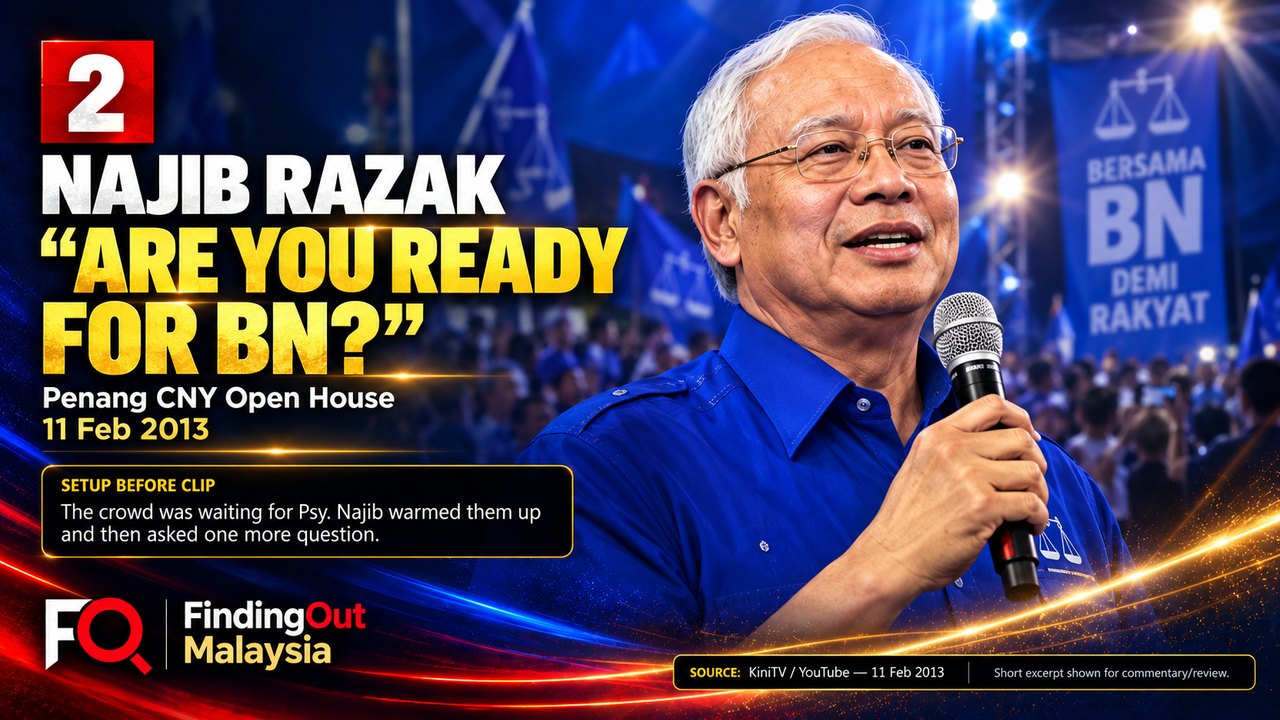
2. Najib Razak — “Are You Ready for BN?”
On 11 February 2013, then-prime minister Najib Razak was speaking at the Penang Barisan Nasional Chinese New Year open house at the Han Chiang College field. The crowd was waiting for South Korean star Psy, whose “Gangnam Style” had become a global phenomenon.
Najib warmed up the audience with a simple call-and-response: “Are you ready for Psy?” The crowd answered enthusiastically. Then he changed one word and asked, “Are you ready for BN?” Contemporary reporting recorded people at the back of the field shouting “No” and laughing.
It was a tiny moment in a much larger event, but it had perfect viral mechanics: expectation, repetition, then an answer that did not follow the script. The clip spread rapidly online and became one of the most replayed political crowd reactions of the GE13 period.
What makes it memorable is not a complicated political argument. It is timing. A routine attempt to lift the energy of the crowd turned into an unscripted response that instantly became the story.
Sources for context: Malaysiakini — PM asks: Are you ready for BN? Crowd says No! (11 Feb 2013)
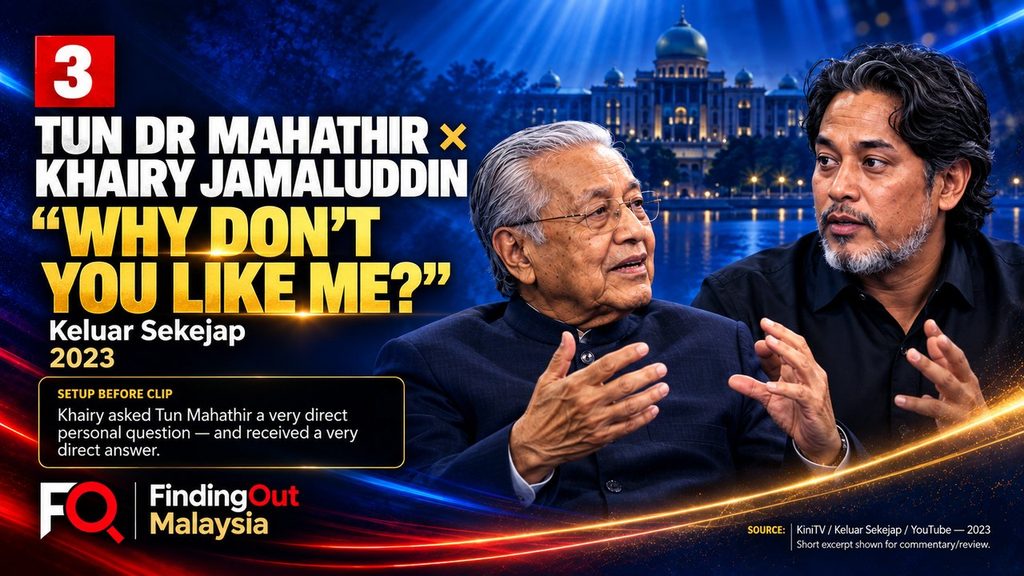
3. Tun Dr Mahathir Mohamad × Khairy Jamaluddin — “Why Don’t You Like Me?”
A question you do not usually ask a former prime minister
In November 2023, Khairy Jamaluddin interviewed former prime minister Tun Dr Mahathir Mohamad on the Keluar Sekejap podcast. Then came a question that was far more personal than the usual policy discussion: “Why don’t you like me?”
Mahathir’s answer was immediate. He said it was because Khairy had contested against his son and because Khairy’s mother-in-law had campaigned for him. Khairy laughed and pushed back. Mahathir replied that it was what people had told him.
The exchange worked because both men understood how blunt it sounded. There was no long build-up, no carefully prepared answer and very little attempt to soften the personal nature of the question. The reaction in the room did the rest.
Mahathir did not specify which contest he was referring to. That detail matters, because the value of this moment is not in trying to reconstruct an entire political rivalry from one sentence. It is simply the unusual sight of two major political figures putting a personal question on the table and answering it almost casually.
Sources for context: Malaysiakini — Dr M answers KJ: Kenapa Tun tak suka saya? (13 Nov 2023)
4. Ahmad Zahid Hamidi — “The Waiting List”
A warning, a laugh — and a very memorable phrase
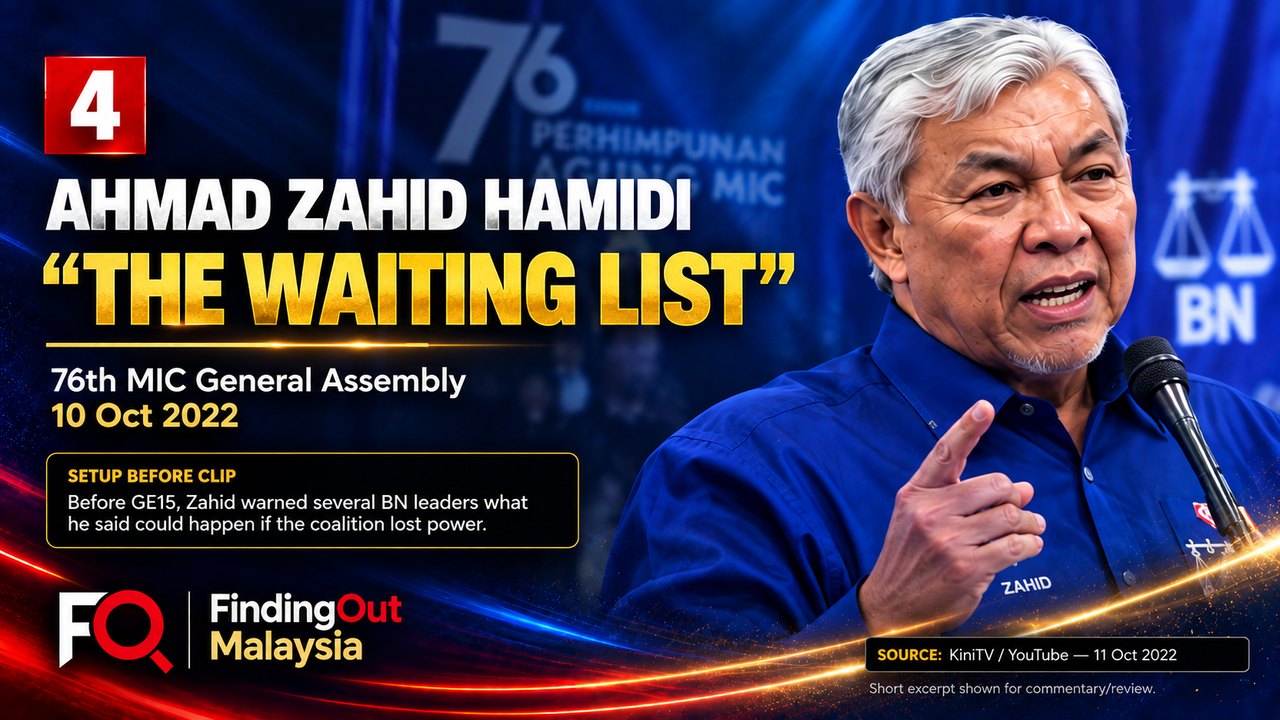
On 10 October 2022, the day Parliament was dissolved ahead of GE15, Barisan Nasional chairman Ahmad Zahid Hamidi addressed the 76th MIC General Assembly. He warned component-party leaders about what he said could happen if BN returned to the opposition benches.
Then came the “waiting list” sequence. Zahid pointed toward several BN leaders — including Mohamad Hasan, S.A. Vigneswaran, M. Saravanan, Wee Ka Siong and Hishammuddin Hussein — while saying they too could face charges. The people around him laughed as he moved from one name to another.
The awkwardness came from the collision between tone and subject. Court cases and prosecution are serious matters, but the delivery was almost conversational, with laughter from some of those being named. Opposition figures seized on the clip and argued that the remarks suggested BN leaders feared prosecution if they lost.
Zahid rejected that interpretation. He said the remarks had been taken out of context and that he had been warning BN leaders about what he described as selective prosecution and political persecution if the coalition lost. For a fair account, both the viral interpretation and his subsequent clarification belong together.
Sources for context: Malay Mail — Zahid says remarks were a warning about selective persecution (13 Oct 2022) | Free Malaysia Today — I meant selective prosecution, Zahid clarifies (12 Oct 2022)
5. Dr Adham Baba — “The Warm-Water Advice”
Warm water, stomach acid and a pandemic
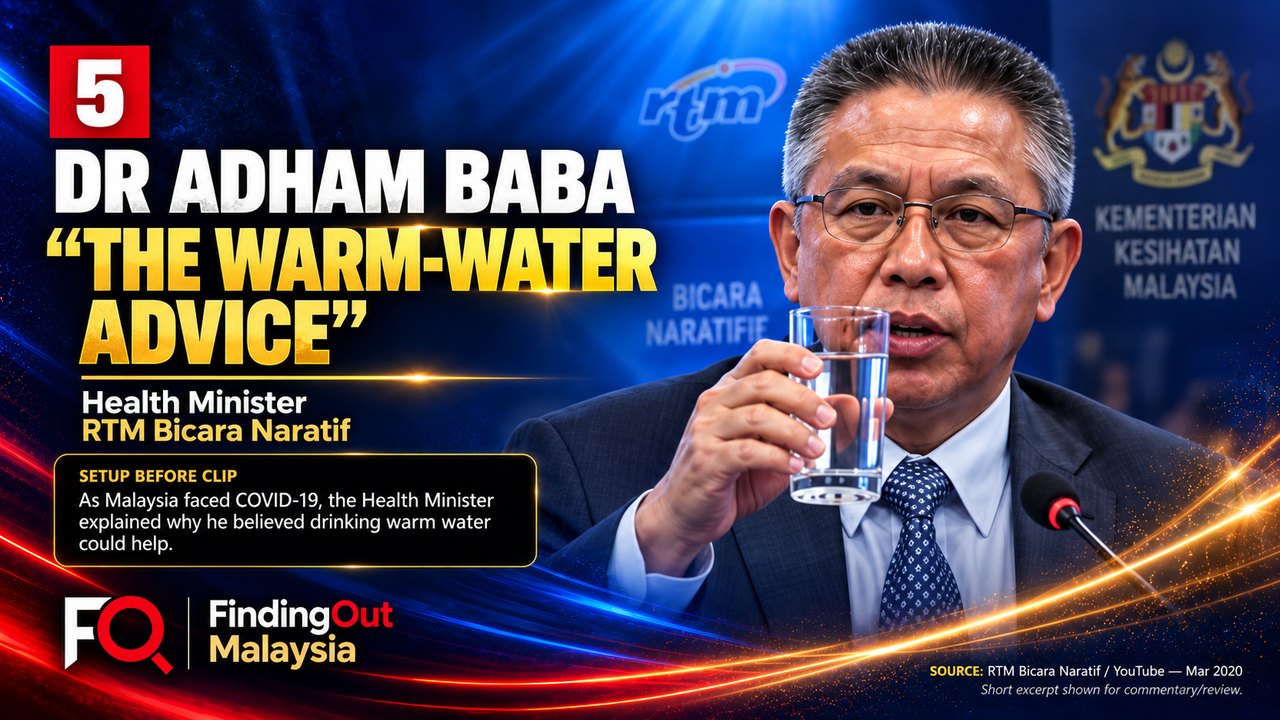
On 19 March 2020, at the beginning of Malaysia’s first nationwide Movement Control Order, then-health minister Dr Adham Baba appeared on RTM’s Bicara Naratif programme to discuss COVID-19.
During the interview, he suggested that drinking warm water could help by washing the virus from the throat into the stomach, where stomach acid would kill it. He also said the virus did not like heat and demonstrated the advice by drinking from a glass.
Medical professionals challenged the claim. Staying hydrated is sensible, but drinking warm water does not prevent coronavirus infection, and there was no evidence that washing the virus into the stomach would stop COVID-19.
That distinction is why the moment deserves context rather than just replay. In March 2020, public anxiety was extremely high and health guidance from an official source carried unusual weight. A simple televised demonstration therefore became one of the most replayed Malaysian pandemic-era clips — and one that required a clear medical correction.
Sources for context: Malay Mail — Health minister says warm water can help flush virus into stomach (20 Mar 2020) | Malay Mail — Medical experts reject warm-water claim (20 Mar 2020)
6. Nurul Izzah Anwar — “Because I Am You”
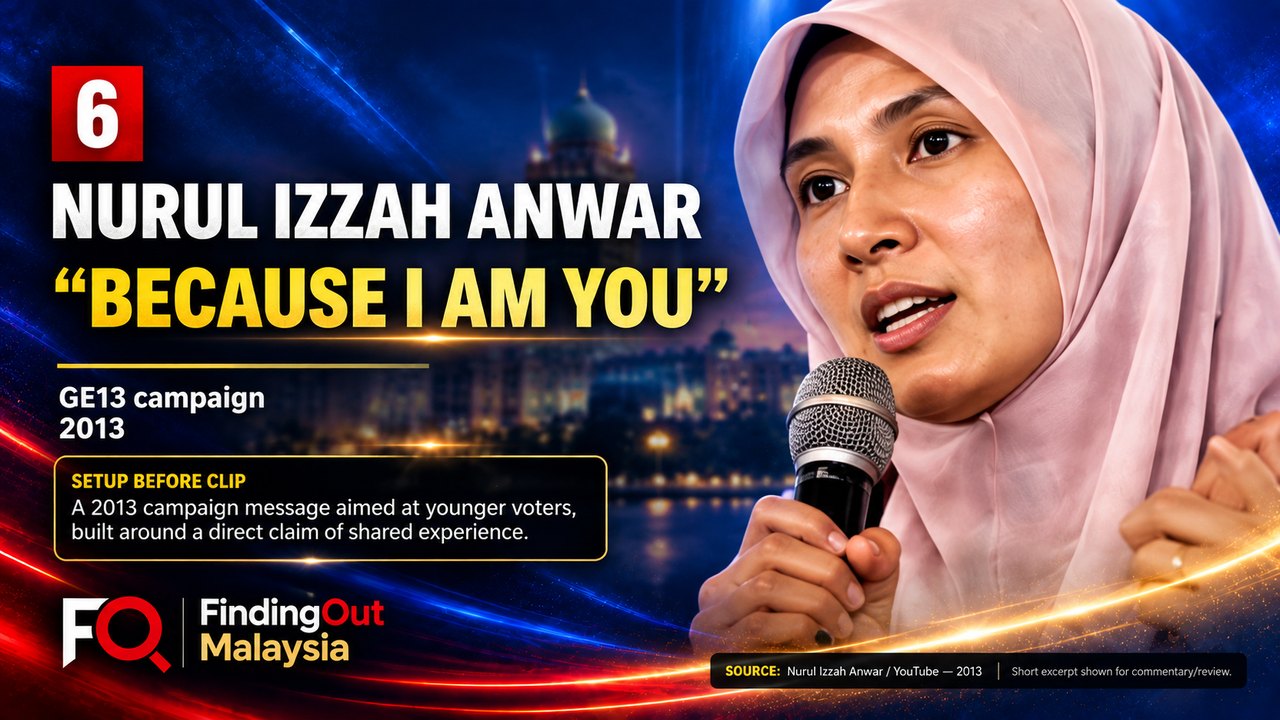
On 1 May 2013, just days before GE13, Nurul Izzah Anwar released a campaign video aimed at younger voters. At the time, she was defending the Lembah Pantai parliamentary seat she had first won in 2008.
The message was built around generational identification. She spoke about Malaysians who had grown up together, shared similar hopes and anxieties, and were now being asked to imagine a different future. The closing line pulled the theme together: “We grew up together, you and I. You know me, you know who I am, and I know you. Because I am you.”
Unlike the other moments in this list, there was no confrontation, factual correction or unexpected crowd reaction. The “cringe” here is entirely about campaign style and delivery. To some viewers, the direct-to-camera earnestness feels overly scripted; to others, it is simply a sincere attempt to identify with younger voters.
That makes it a useful final entry. Not every awkward political moment is a gaffe. Sometimes the same line can sound moving to one person and painfully rehearsed to another. That subjectivity is exactly why this list ends with a question rather than a verdict.
Sources for context: Nurul Izzah Anwar / YouTube — GE13 campaign video (1 May 2013)
So, which one was the most cringe?
These six moments span more than a decade of Malaysian politics: a campaign video, a Chinese New Year rally, a party assembly, a health broadcast, a podcast and a press conference. They involve different parties, different personalities and very different kinds of awkwardness.
What they have in common is that each escaped the setting in which it happened and took on a second life as a clip — replayed, quoted, argued over and remembered long after the original event ended.
Our ranking is deliberately left open. Which moment made you cringe the most — and is there another Malaysian political moment that deserves to be on the list? Watch the full video and tell us in the YouTube comments.
Editorial & Source Note
This feature uses short excerpts from publicly available recordings for commentary, criticism, review and public-interest discussion. Copyright in the original footage remains with the respective rights holders.
The clips have been shortened for presentation and are not intended to alter the meaning of the original remarks. Where relevant, subsequent apologies, clarifications or factual corrections have been included so that the moments are presented with appropriate context.
The description “cringe-worthy” is a subjective editorial judgment. FindingOut Malaysia does not endorse or oppose any of the political figures featured here, and readers are invited to watch the clips and form their own views.
More from FindingOut Malaysia
For more Malaysian current affairs, business and public-interest stories, subscribe to FindingOut Malaysia on YouTube and visit findingout.com.
Malaysia can look deeply troubled from the headlines.
Political controversy, concerns about governance, rising living costs and pressure on household budgets can easily create the impression that the country is moving in the wrong direction.
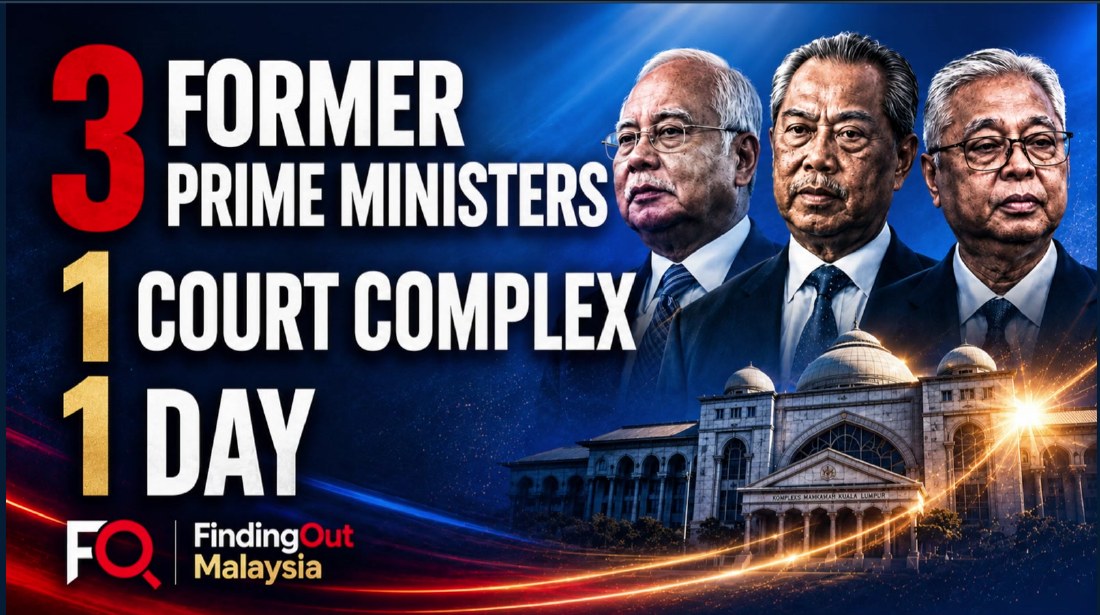
On 27 August 2026, three former Malaysian prime ministers — Najib Razak, Muhyiddin Yassin and Ismail Sabri Yaakob — appeared at the same court complex in Kuala Lumpur on the same day for three separate and unrelated proceedings.
To some, that image may represent everything that has gone wrong with Malaysian politics. To others, it may suggest that even former national leaders remain answerable to institutions and the courts.
Malaysia has advantages that are easy to overlook.
It sits beside the Strait of Malacca, between the Indian Ocean and the major economies of East Asia. It has major ports, established manufacturing, natural resources, energy infrastructure and strong trading links with the wider world.
Malaysia is also comparatively fortunate geographically. While neighbouring Indonesia and the Philippines face some of the world’s most active earthquake and volcanic zones, much of Malaysia lies outside the most intense parts of the Pacific Ring of Fire.
Its multicultural population and widespread use of Bahasa Malaysia and English also help the country connect across different markets and cultures.
The Numbers Tell Another Story
Malaysia’s economy has continued to grow.
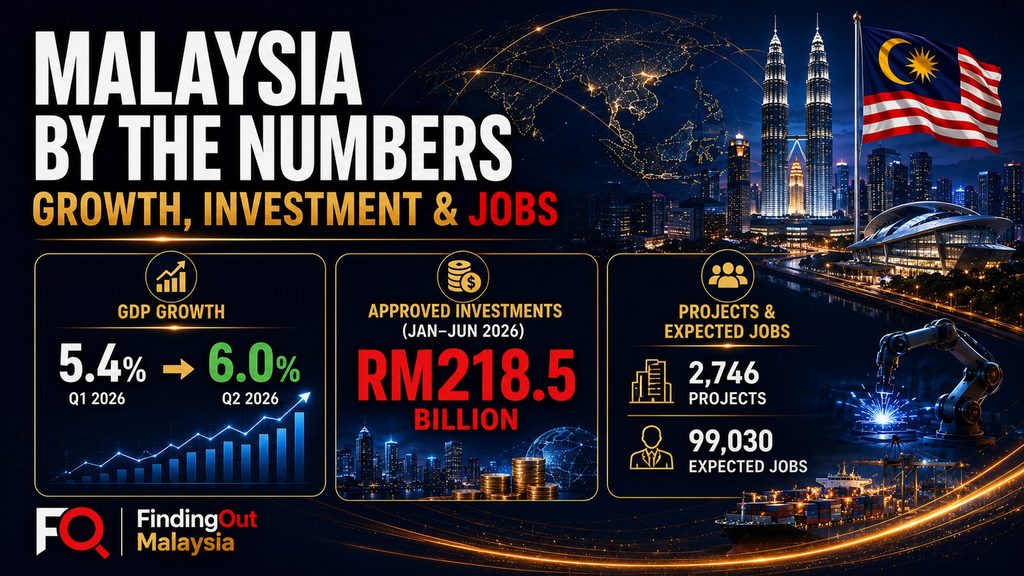
GDP growth strengthened from 5.4% year-on-year in Q1 2026 to 6.0% in Q2 2026.
In the first half of 2026, RM218.5 billion in investments were approved across 2,746 projects, with approximately 99,030 jobs expected. Investment is also moving into electronics, semiconductors, renewable energy, battery storage, data centres and digital infrastructure.
Approved investment is not the same as money already spent, and projected jobs are not jobs already created. But the direction matters.
Serious capital has not written Malaysia off.
So Why Does Life Still Feel So Expensive?
This is where the story becomes more complicated.
Economic growth can look healthy while ordinary households still feel under pressure.
People experience the economy through rent, groceries, transport, petrol and monthly bills — not GDP percentages.
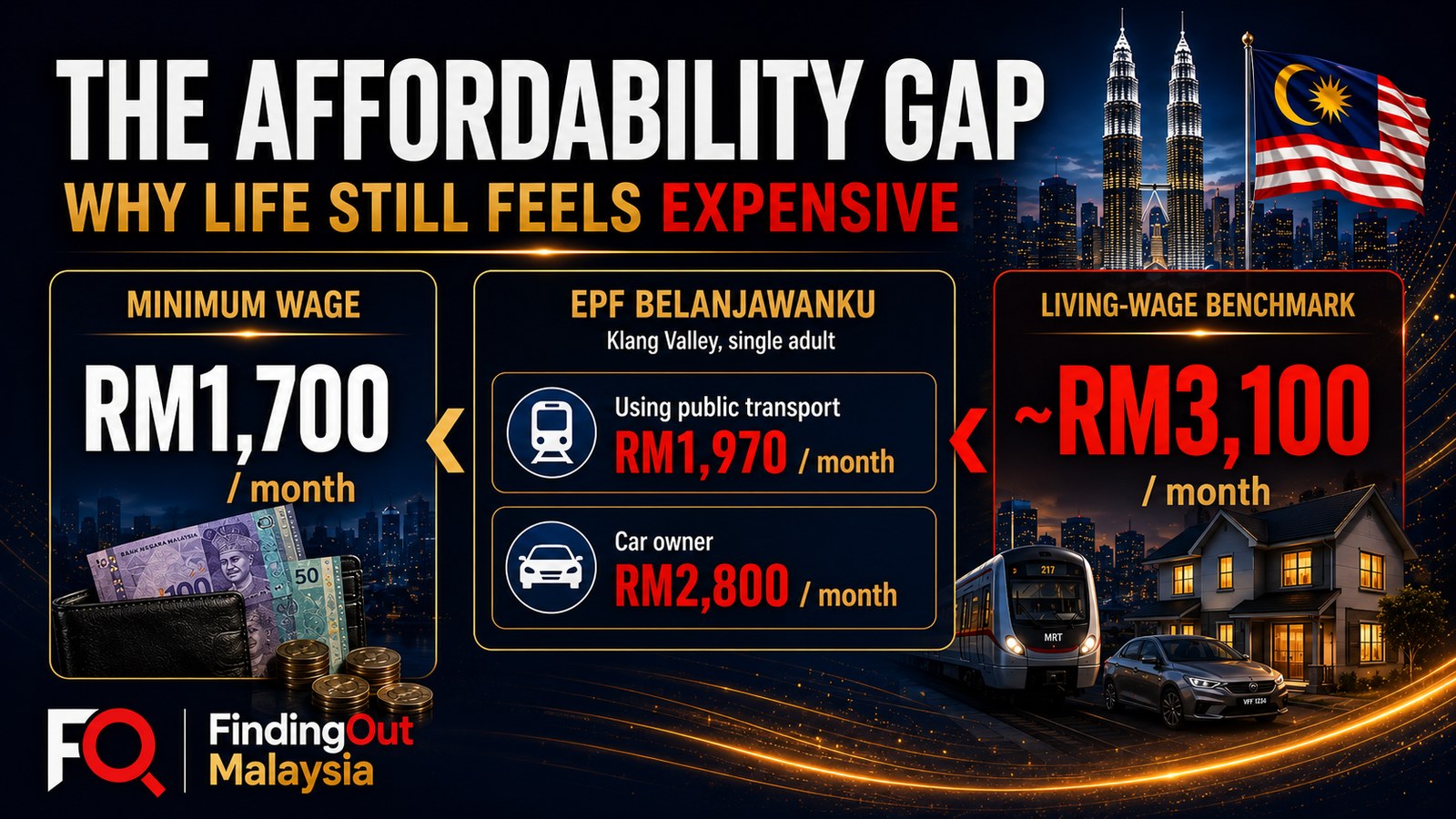
Malaysia’s minimum wage is RM1,700 per month. EPF’s Belanjawanku estimates suggest that a single adult in the Klang Valley may need around RM1,970 per month using public transport, with substantially more required for a car owner.
That helps explain why positive economic statistics do not always feel like prosperity.
The challenge is not simply to make the economy bigger. It is to turn growth into better jobs, stronger wages and higher household prosperity.
Malaysia’s Story Isn’t Finished
Malaysia was not dealt a bad hand.
Geography helped. Resources helped. Trade helped. Investors are still willing to put money into its future.
But no advantage guarantees success.
What matters is how well Malaysia develops its people, raises productivity, executes effectively and turns opportunity into better lives.
Malaysia’s future is not guaranteed. But neither is decline.
Perhaps Malaysia is not finished.
Perhaps Malaysia simply has not finished becoming what it could be.
Want the Full Story?
Watch “What If Everyone Is Wrong About Malaysia?” on FindingOut Malaysia on YouTube.
A layperson’s look at the 0.19% online clue, halal/Shariah positioning and what I saw in the shops.
Disclosure: I own shares in RT Pastry Holdings Berhad. This article reflects my personal views and is for information and commentary only. It is not investment advice or a recommendation to buy, sell or hold any security. Please do your own research and seek professional advice where appropriate.
RT Pastry is not the sort of investment idea that needs an elaborate story. It makes bread, cakes and pastries, listed on Bursa Malaysia’s ACE Market on 29 June 2026 at 18 sen a share, and closed at 13.5 sen on Monday, 24 August 2026 – 25% below the IPO price. [2] [9]
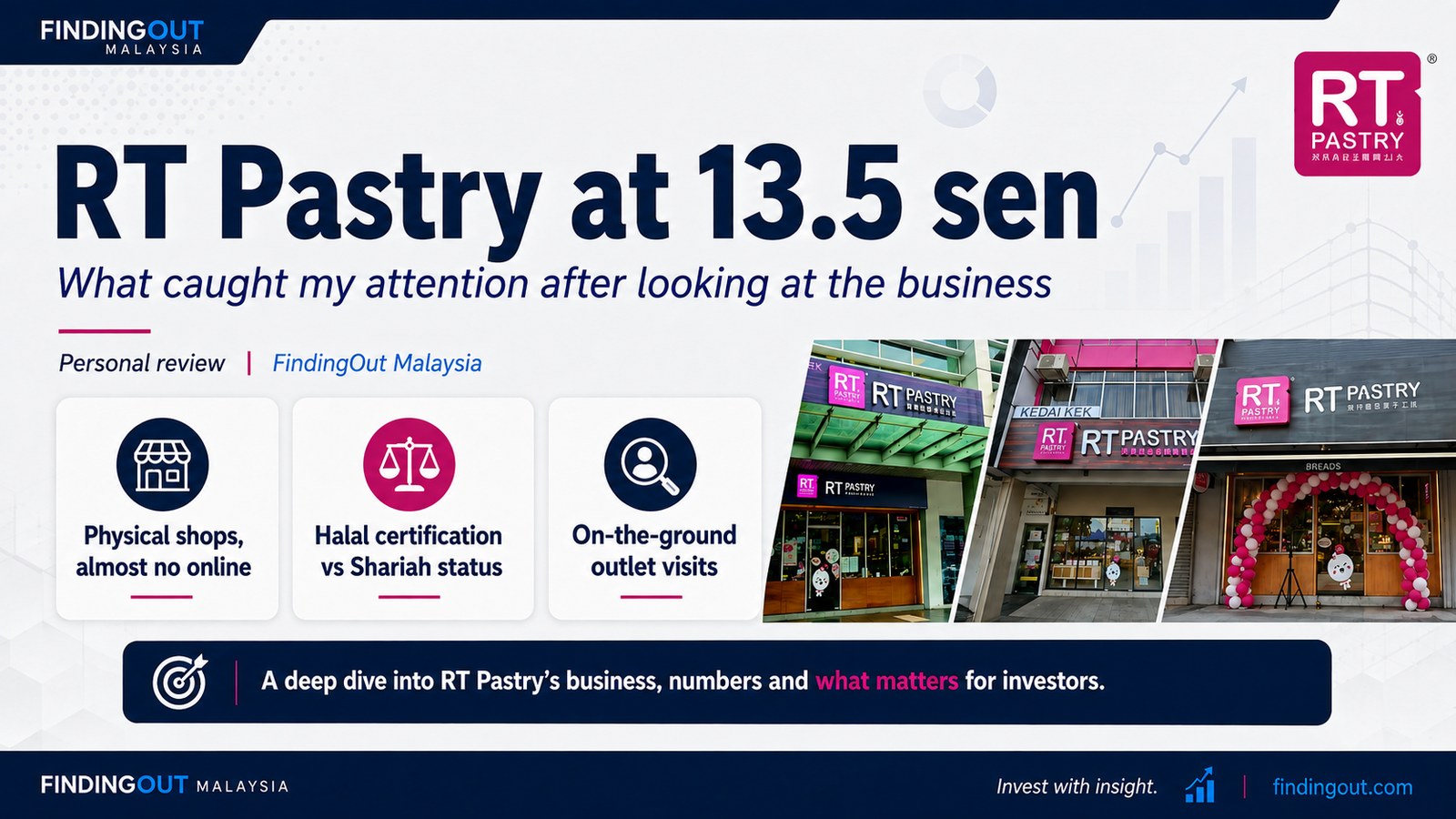
That fall is what makes the stock noticeable, but it is not what makes the story interesting to me. I am more interested in three practical observations: online sales are still almost invisible, the halal position has improved while the shares remain Shariah non-compliant, and I have actually spent time looking at the business in its shops.
Those three angles are the heart of this commentary. The financial accounts and valuation still matter, but I would rather ask whether an established bakery can reach more customers and whether that opportunity starts to show up in sales, margins and cash generation.
1. The 0.19% clue: online sales are still almost invisible
The single number that caught my attention most was not 13.5 sen. It was 0.19%.
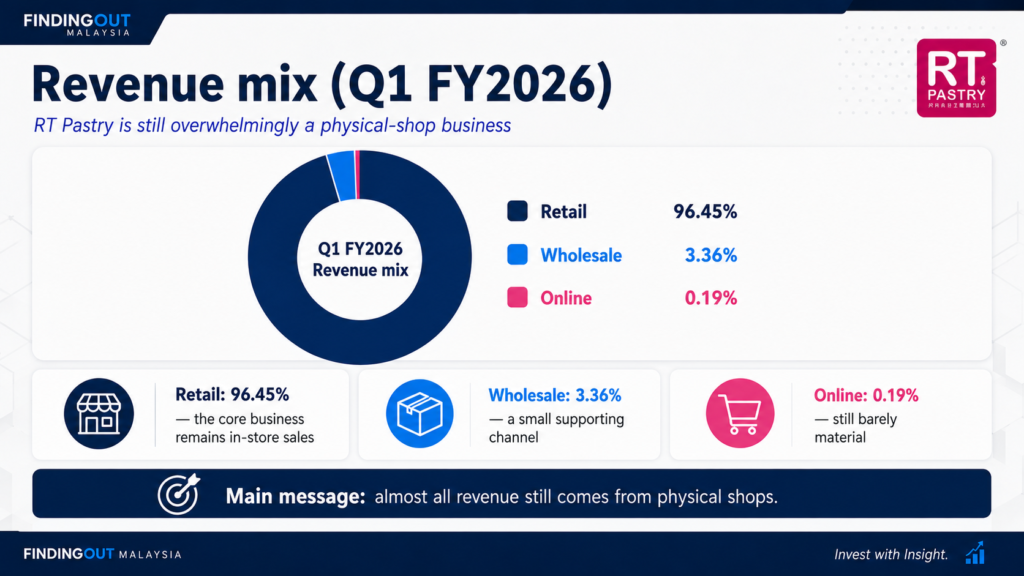
For Q1 FY2026, RT Pastry recorded revenue of RM12.657 million. Physical retail outlets contributed 96.45% of total sales, wholesale contributed 3.36%, and the company’s own online platform contributed only about RM24,000 – 0.19%. [3]
RT Pastry Q1 FY2026 Revenue Mix
To me, this is both a weakness and an opportunity. RT Pastry already operates an online shop, so it is not starting from zero. But economically, digital sales are still tiny compared with the physical network. [1]
Could delivery become another shopfront?
An office ordering pastries for a meeting, a family wanting a cake delivered, or someone buying breakfast without travelling to a store are ordinary use cases. If RT Pastry can place more of its range where customers already search for food – through its own shop, delivery partners or larger marketplaces – each outlet could potentially reach beyond its immediate catchment without a new shop for every new customer.
I would not assume this is free growth. Delivery commissions, packaging, promotions, fulfilment and possible cannibalisation of walk-in sales can dilute the benefit. The relevant test is not whether online orders increase; it is whether incremental digital revenue can be earned at a sensible margin.
What I will watch: online contribution, repeat digital ordering, delivery economics and whether digital reach adds customers rather than simply shifting existing store sales.
2. Halal certification and Shariah status: two different issues, one important checkpoint
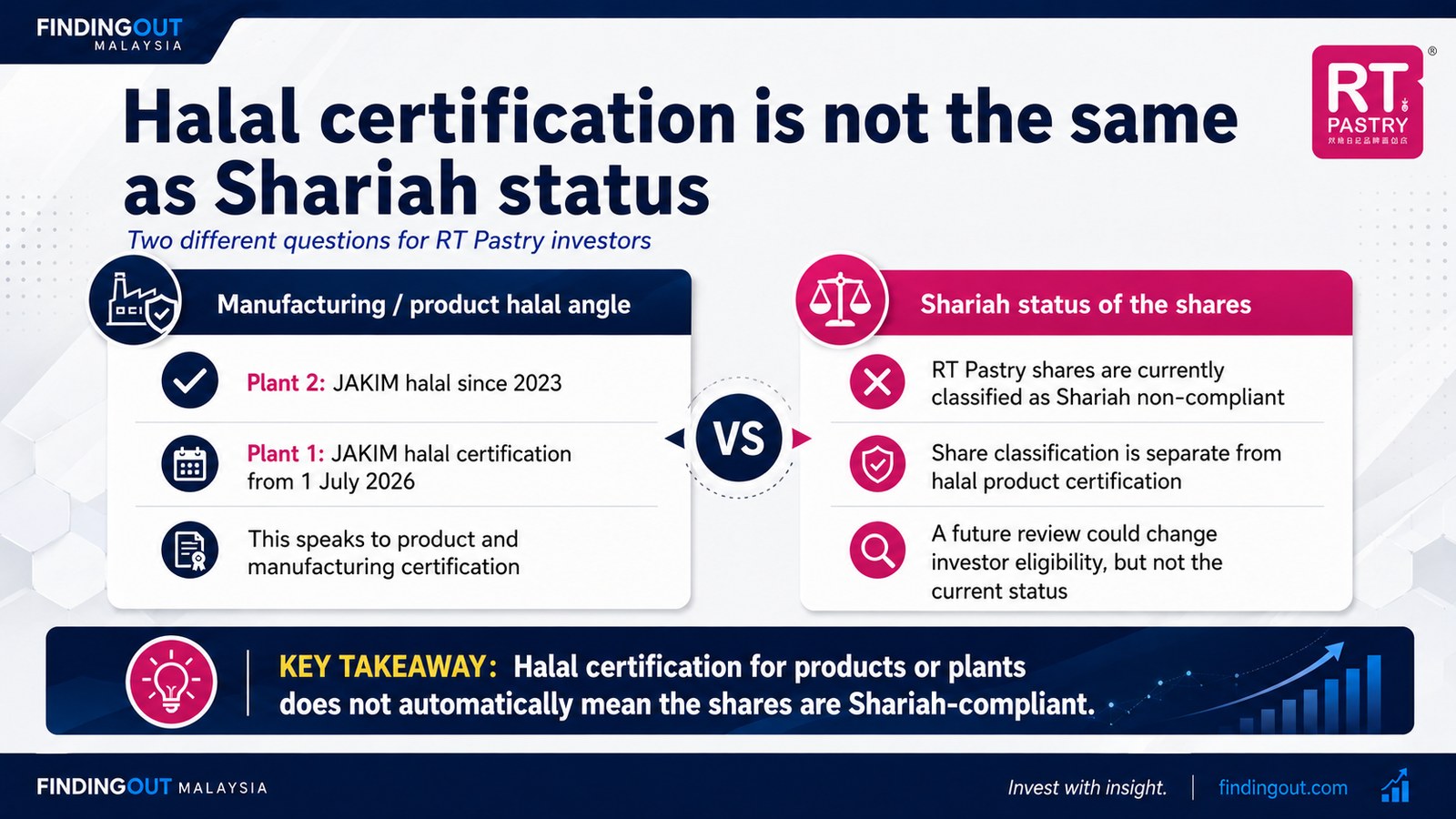
My second angle is the Muslim consumer and investor market, but two ideas have to stay separate: halal certification of the food/manufacturing business and Shariah-compliant status of the shares are not the same thing.
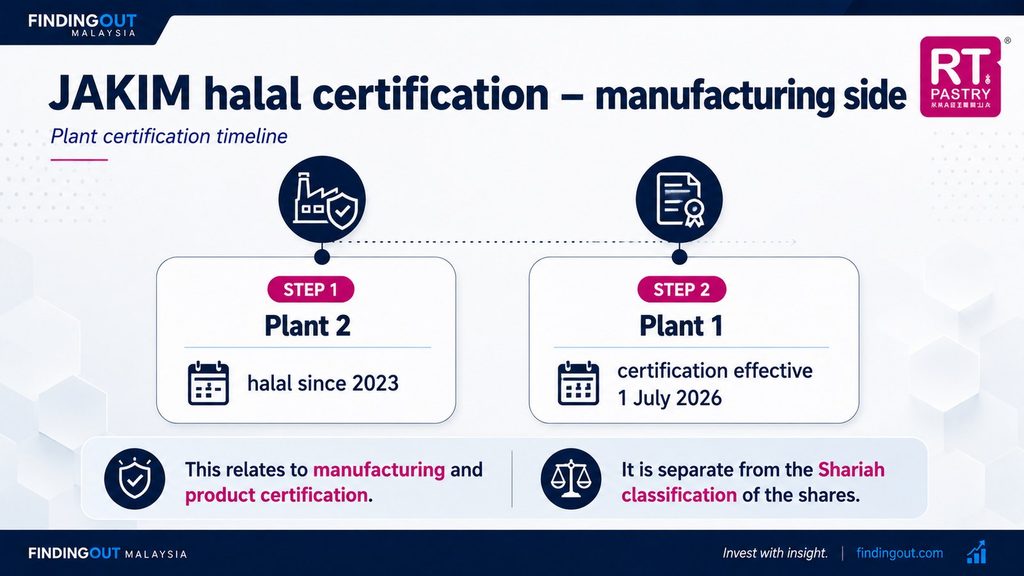
RT Pastry’s Plant 2 facility in Glenmarie has held JAKIM halal certification since 2023. Plant 1 in Taman Bukit Serdang obtained JAKIM certification effective 1 July 2026, valid until 30 June 2028. That means both central manufacturing plants now have halal certification. [5] [6]
RT Pastry Halal Certification Timeline
Commercially, I think that matters. Management has talked about broadening market reach beyond the Klang Valley, strengthening wholesale distribution and developing OEM business. A stronger halal platform could help the company reach Muslim consumers and corporate customers with clearer assurance. [4] [6]
But the shares themselves are currently classified as Shariah non-compliant on the Securities Commission Malaysia’s pre-listing status page, updated on 11 June 2026. The SC screening process considers business activities as well as financial-ratio benchmarks, so halal certification does not automatically change the share classification. [7] [8]
RT Pastry Halal vs Shariah Status
One outlet-level observation – not a regulatory finding
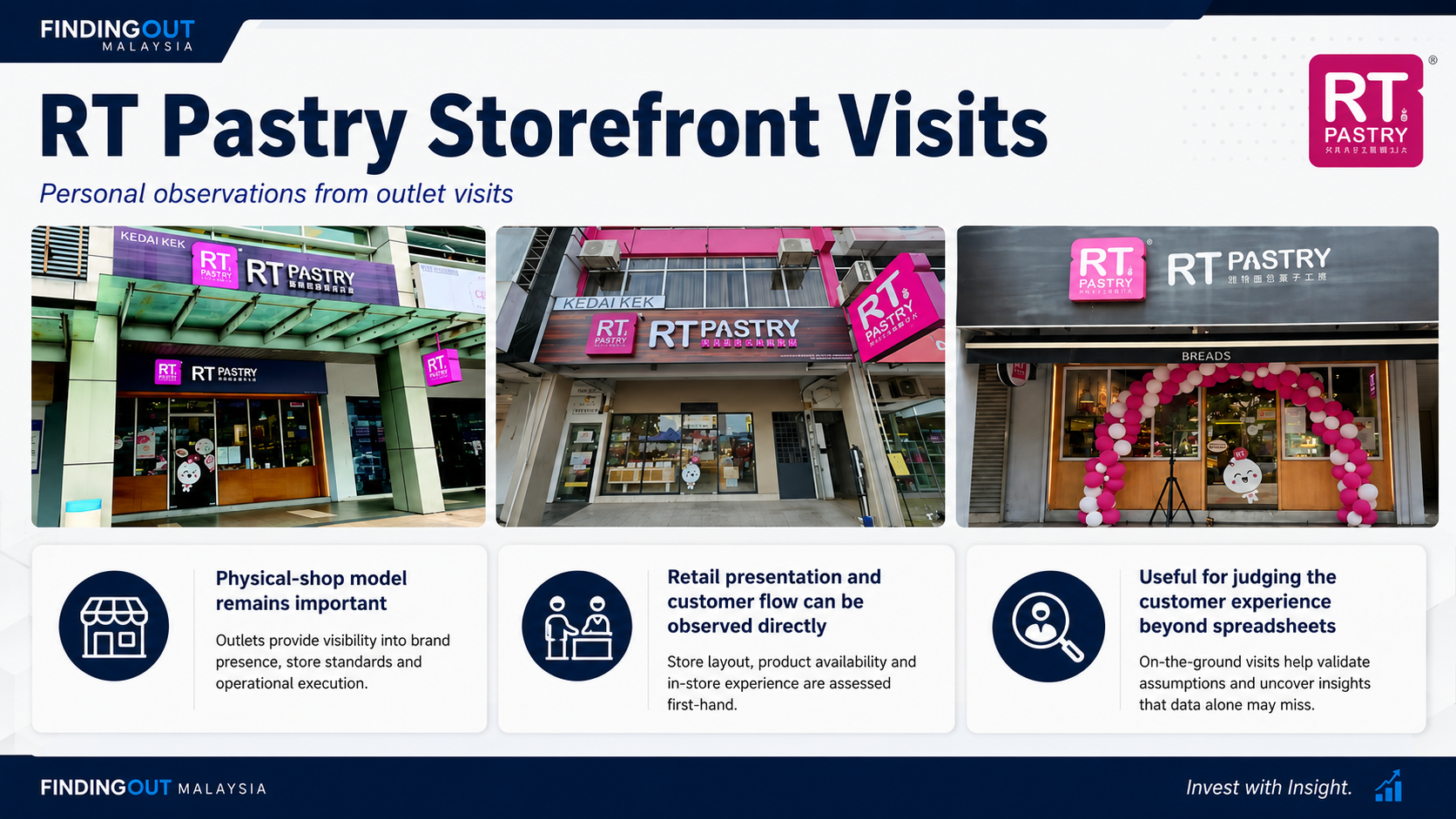
At the Taman Segar and Taman Desa outlets I visited, I did not see the familiar JAKIM halal logo displayed at the shopfront. I treat that only as a personal observation. Before publication I could verify the central manufacturing certification; I have not independently established separate outlet-level JAKIM certification for those two branches. [11]
The SC says its Shariah-compliant securities list is updated twice a year, in May and November. That makes the next November review – scheduled for 27 November 2026 – a natural checkpoint for me to watch, not something I would predict in advance. [8]
3. What I saw in the shops: anecdotal, but still worth noticing
My third angle is the least scientific, but it is the most personal.
I have visited RT Pastry outlets in Taman Segar and Taman Desa on several occasions. I have not conducted formal customer counts and two branches cannot represent an entire business. Nevertheless, the stores I visited appeared to have a fairly steady flow of customers. I also noticed Muslim customers purchasing products. [11]
RT Pastry Storefront Visits
This does not prove same-store sales are rising or that every outlet is busy. But it gave me a reason to look further. The shops I saw did not feel like a brand customers had deserted. For a consumer business, I think that sort of real-world observation is worth placing beside the accounts – carefully, without pretending it is hard data.
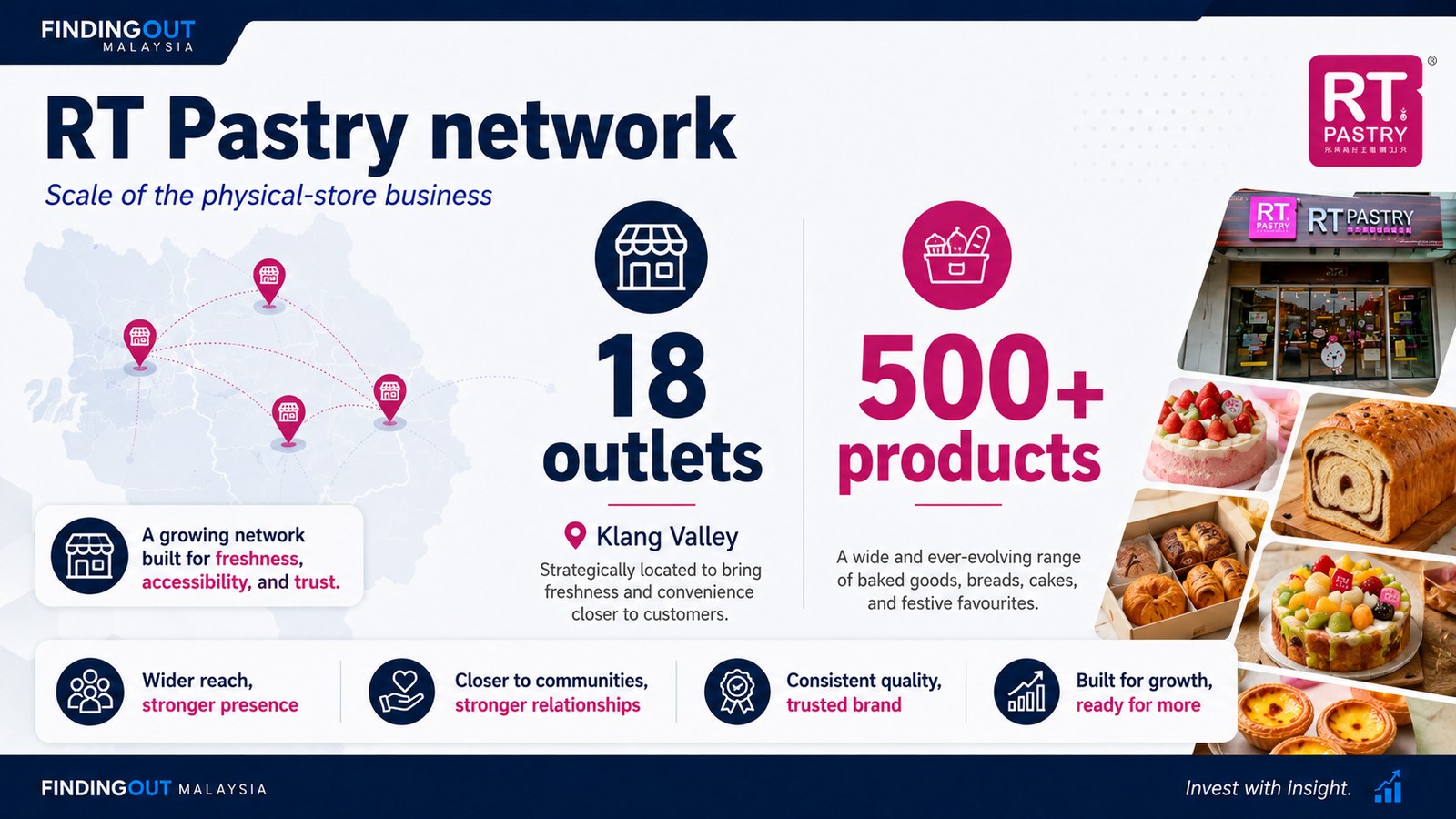
RT Pastry’s current website says the brand has 18 outlets across the Klang Valley and more than 500 bakery products. At the IPO it had 17 outlets, so the physical network has already moved forward at least one step. [1] [2]
RT Pastry 18 Outlets and 500 Plus Products
Why the physical network matters
A store-led business has disadvantages – rent, labour and the need to attract local footfall – but it also gives RT Pastry a tangible customer relationship. The investment question is whether that physical base can become a platform for wider distribution rather than remaining the only meaningful channel.
My takeaway: the stores are not proof of growth, but they are evidence worth testing against future revenue, margins and customer reach.
4. What does 13.5 sen actually mean?
A price 25% below the IPO price can look cheap, but a lower share price is not the same thing as a lower-risk investment. I therefore prefer to anchor the valuation to what the company has actually earned.
With 339.042 million shares after the IPO, 13.5 sen implies a market capitalisation of roughly RM45.8 million. Against FY2025 profit attributable to owners of RM6.006 million, that is about 7.6 times reported earnings. The prospectus also discloses that FY2025 included a net RM0.746 million gain on the disposal of the Balakong plant; excluding that gain, attributable profit was RM5.260 million and the same 13.5-sen reference price equates to about 8.7 times adjusted earnings. [2]
The history is steady rather than spectacular. Revenue rose from RM54.747 million in FY2022 to RM60.312 million in FY2025. Attributable profit was RM5.877 million, RM6.234 million, RM5.013 million and RM6.006 million across FY2022-FY2025. [2]
The Q1 reality check
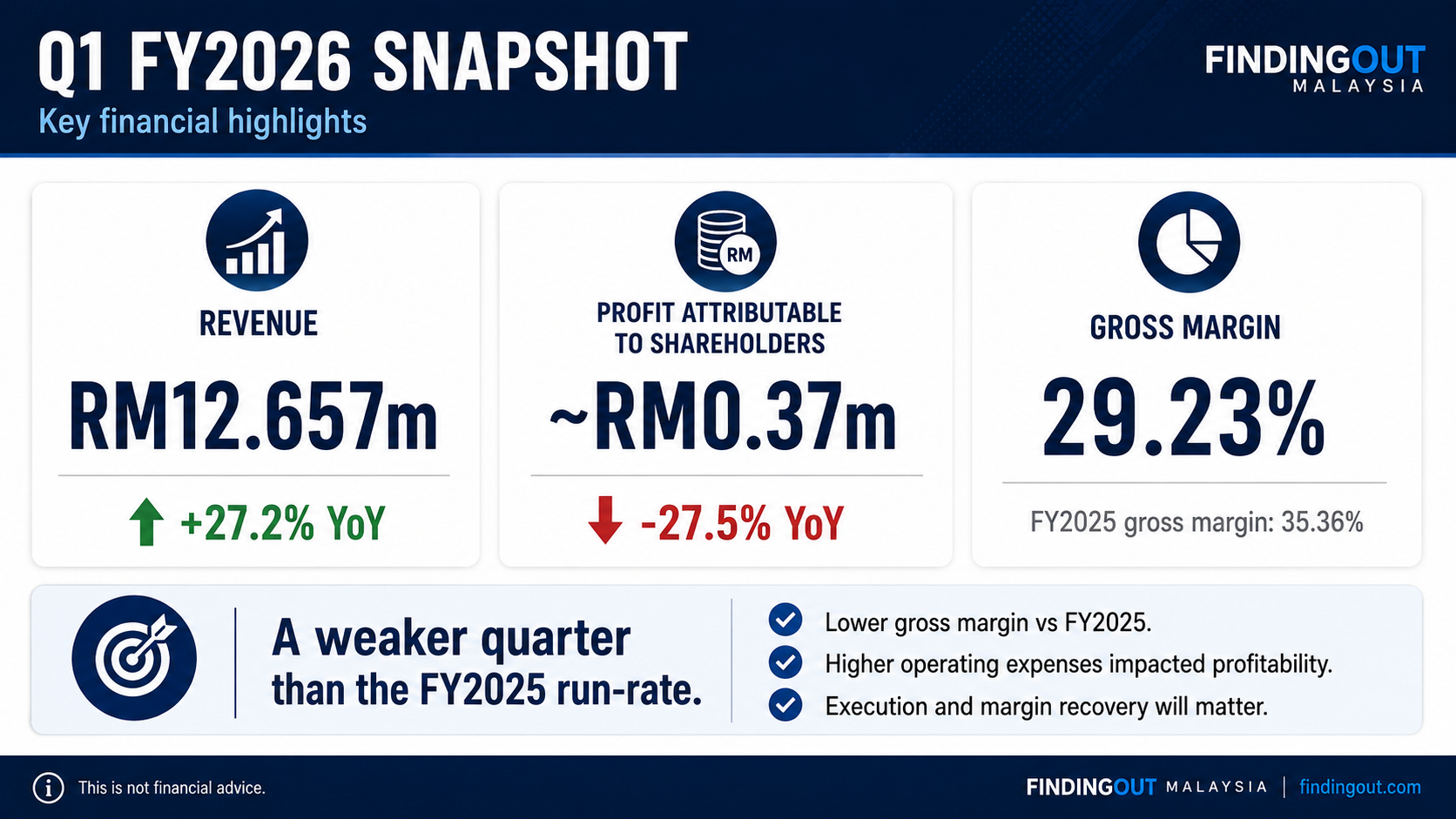
Q1 FY2026 revenue was RM12.657 million, profit attributable to owners was about RM370,000 and gross margin was 29.23%, below FY2025’s 35.36%. That is a legitimate reason for caution. [3]
RT Pastry Q1 FY2026 Financial Snapshot
Management later said the lower first-quarter net profit margin was mainly affected by a higher effective tax rate from non-deductible expenses rather than weaker core operations. Even so, I want the next few quarters to show that margins and earnings can improve – not simply assume a low historical P/E makes the shares a bargain. [4]
5. The three angles fit together
This is where the story becomes more interesting to me. The three observations are not separate.
RT Pastry already has a visible physical customer base and almost all current sales still come through stores.
Both central manufacturing plants now have halal certification, which may help broaden consumer and commercial reach.
The digital channel is so small that online distribution remains an under-developed route to reach more customers.
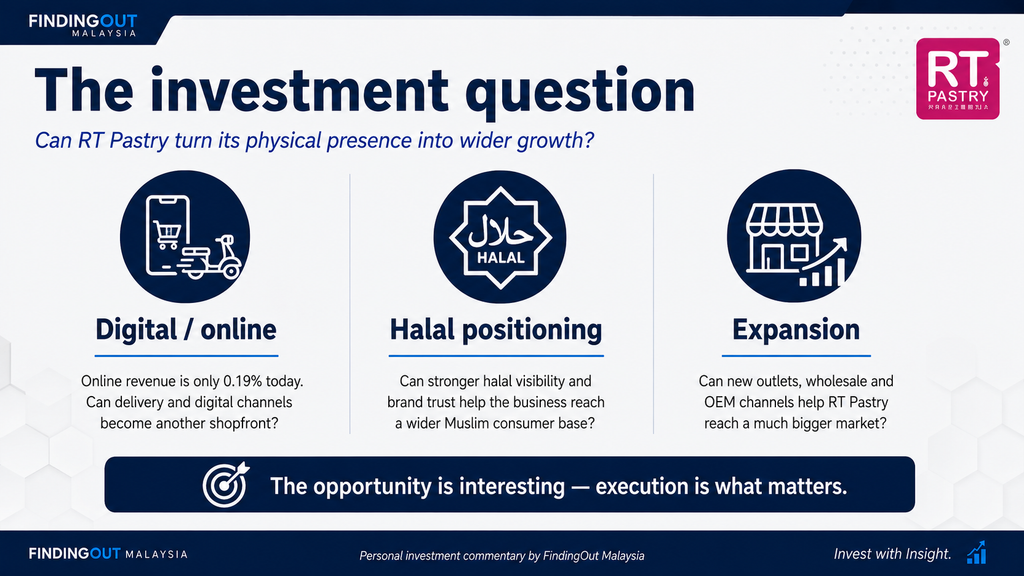
RT Pastry Investment Question
Put differently, the opportunity I am watching is not simply “open more bakeries”. It is whether RT Pastry can take an existing product range and brand, broaden its addressable customer base, and distribute those products through more channels.
Management has set a target of at least 10% annual sales growth while expanding beyond the Klang Valley and strengthening wholesale and OEM business. The IPO plan also allocated proceeds to six new outlets – four in the Klang Valley and two in Pahang. Those are company targets and plans, not my forecasts. [2] [4]
What would strengthen the thesis?
Online revenue becomes meaningful without destroying margin.
New outlets expand reach while existing outlets remain productive.
Wholesale and OEM become material contributors rather than side businesses.
Halal positioning translates into broader consumer or commercial demand.
Gross margin and cash generation improve as the post-IPO business scales.
The opportunity is interesting. Execution is what matters.
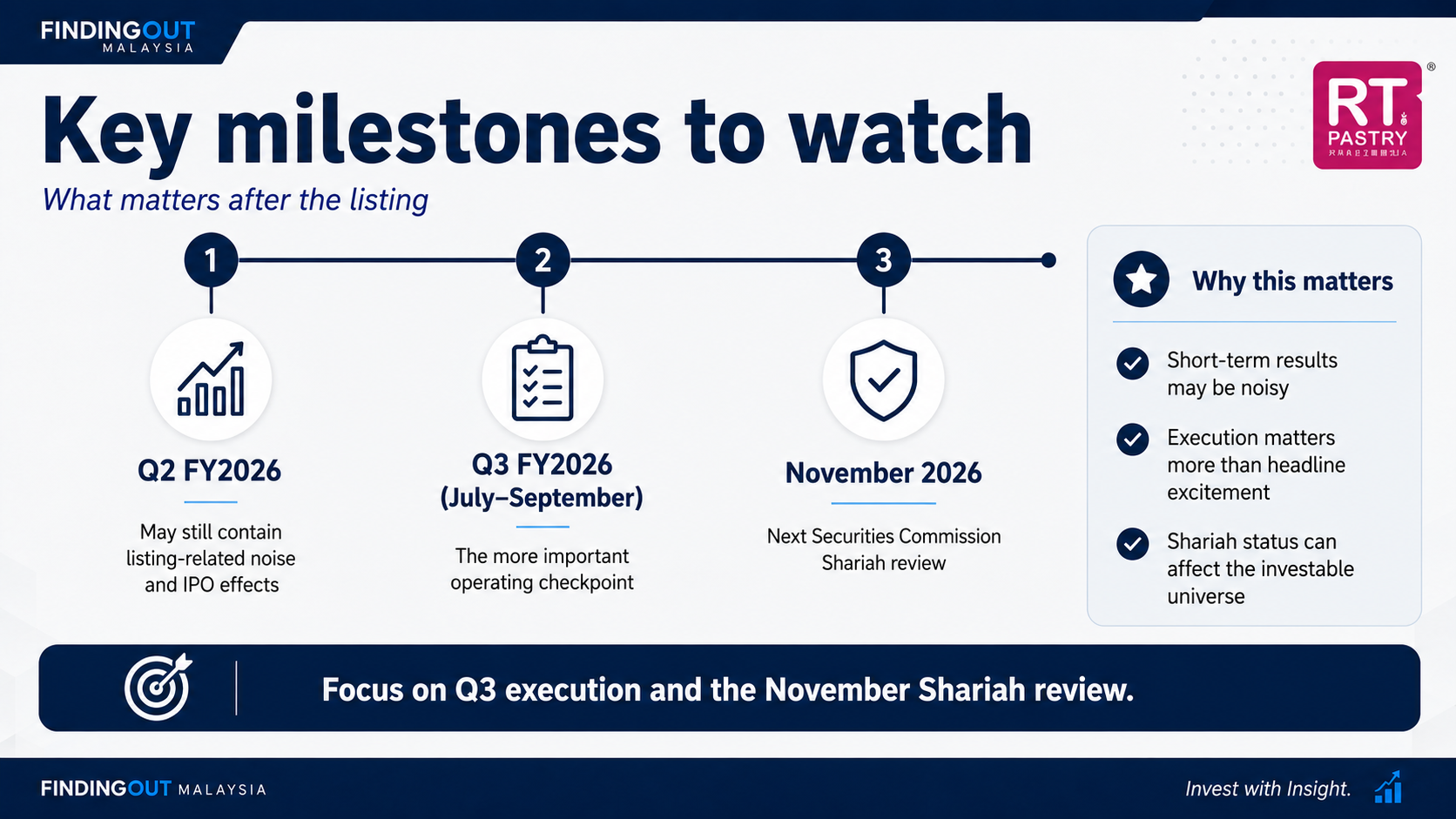
6. My personal plan: Q2, Q3 and the November Shariah review
I already own RT Pastry shares, so I have money at risk in this thesis. My approach is not to make the immediate post-IPO quarter the decisive test.
Q2 FY2026 covers April to June, and RT Pastry listed on 29 June – right at the end of that quarter. The IPO prospectus budgeted about RM4.13 million for listing expenses, although different costs can receive different accounting treatment and I would not assume the whole amount runs through one quarter’s profit-and-loss account. For that reason, I will read Q2 but I do not want to overreact to one headline number. [2]
The more important earnings checkpoint for me is Q3 FY2026, covering July to September. It is the first full quarter after listing and should provide a cleaner view of the underlying retail business, gross margin, digital contribution and early post-IPO execution.
The other key date is 27 November 2026, when the next scheduled SC Shariah-compliant securities list is due. This is an SC Shariah Advisory Council process, not a Bursa Malaysia decision. I am not assuming RT Pastry will be reclassified. I simply see the date as another piece of evidence. [7] [8]
RT Pastry Key Milestones to Watch
What I will be watching
Quarterly revenue and same-store/retail momentum.
Gross margin recovery from the 29.23% Q1 level.
Online sales from the current 0.19% base.
Wholesale and OEM contribution.
New-outlet execution and Pahang expansion.
Cash generation and whether growth converts into earnings.
The November Shariah classification update.
My position for now: watch Q2, place greater weight on Q3, then reassess the business and the November Shariah checkpoint with fresh evidence.
My position for now
For me, the question is no longer whether RT Pastry simply returns to its 18 sen IPO price. I do not treat 18 sen as a target. The better question is whether the company can use its capital, halal platform, physical network and new distribution options to become a broader and more profitable bakery business.
That means I will be watching three things above all: whether online channels become meaningful, whether the halal/Shariah story develops in a way that broadens the customer and investor base, and whether the real-world customer demand I have observed translates into stronger business performance.
The opportunities are interesting. Execution is what matters.
Personal views. Malaysian companies. My own research.
Disclosure and Important Notice
I currently hold shares in RT Pastry Holdings Berhad and therefore have a financial interest in the company discussed in this article. My ownership may influence my interpretation of the company, and readers should take that potential bias into account.
I am not a financial adviser, securities analyst, stockbroker, investment professional or licensed investment adviser. I do not claim to be an expert or to hold any professional qualification in investment analysis. This article records my personal observations, research and interpretation of publicly available information.
Nothing in this article constitutes personalised investment advice, a research recommendation, an offer or a solicitation to buy, sell or hold any security. Share prices can rise or fall substantially and investors may lose part or all of their investment. Readers should conduct their own research and, where appropriate, obtain advice from a properly licensed professional.
Data note: 13.5 sen is the closing-price reference used for this commentary from 24 August 2026. It is not a live price. Delivery-platform availability can vary by outlet and location, and Shariah classification is time-sensitive. These points should always be checked against the latest available information.
Regulatory note
The Securities Commission Malaysia has clarified that sharing factual or educational information generally differs from providing investment advice, but recommendations or opinions that may induce someone to buy, sell or hold an investment can fall within regulated investment-advice activity depending on the circumstances. A disclaimer alone does not determine the regulatory position. This article is intentionally framed as disclosure of my own observations and decision-making rather than personalised advice to readers. [10]
Sources and Reference Notes
RT Pastry official website / Investor Relations – Open source – current 18-outlet footprint, 500+ products, online shop and corporate overview.
RT Pastry IPO Prospectus / prospectus launch – Open source – 18-sen IPO, listing date, proceeds, audited FY2022-FY2025 financials, enlarged share base and adjusted FY2025 earnings.
The Edge Malaysia – ACE Market-bound RT Pastry posts RM0.37m net profit for 1Q – Open source – Q1 FY2026 revenue, retail contribution, gross margin and attributable profit.
The Edge Malaysia – RT Pastry targets 10% annual sales growth – Open source – management growth target, wholesale/OEM plans and domestic expansion.
The Star – RT Pastry secures JAKIM halal certification for manufacturing facility – Open source – Plant 1 certification effective 1 July 2026, valid to 30 June 2028.
Utusan Malaysia – RT Pastry sasar ruang pasaran baharu dengan sijil halal – Open source – Plant 2 certified since 2023 and commercial halal strategy.
Securities Commission Malaysia – Shariah status for companies seeking listing – Open source – RT Pastry pre-listing status: Non-Compliant, updated 11 June 2026.
Securities Commission Malaysia – Shariah-compliant securities and screening methodology – Open source – May/November update cycle and business/financial screening framework.
The Star MarketWatch – RT Pastry Holdings Berhad (RT, 0461) – Open source – 13.5-sen closing price on 24 August 2026.
Securities Commission Malaysia – Guidance Note on Provision of Investment Advice – Open source – guidance on factual/educational content versus investment advice.
Author’s personal observations – Personal source – visits to RT Pastry outlets in Taman Segar and Taman Desa; anecdotal observations only, not independently measured footfall data.
Editorial notes
The Q1 FY2026 figures are from RT Pastry’s maiden quarterly report; no year-on-year comparison was available in that report.
The 7.6x and 8.7x P/E figures are simple backward-looking calculations at 13.5 sen and are not target prices.
The November Shariah review is a checkpoint, not a prediction of reclassification.
Any future website update should refresh the share price, outlet count, delivery availability and Shariah status before republishing.
Disclosure: I currently own shares in Astro Malaysia Holdings Berhad and therefore have a financial interest in the company. I am not a licensed financial adviser, securities analyst, stockbroker or professional investor. This article records my personal observations and reasoning and is not investment advice or a recommendation to buy or sell Astro shares.
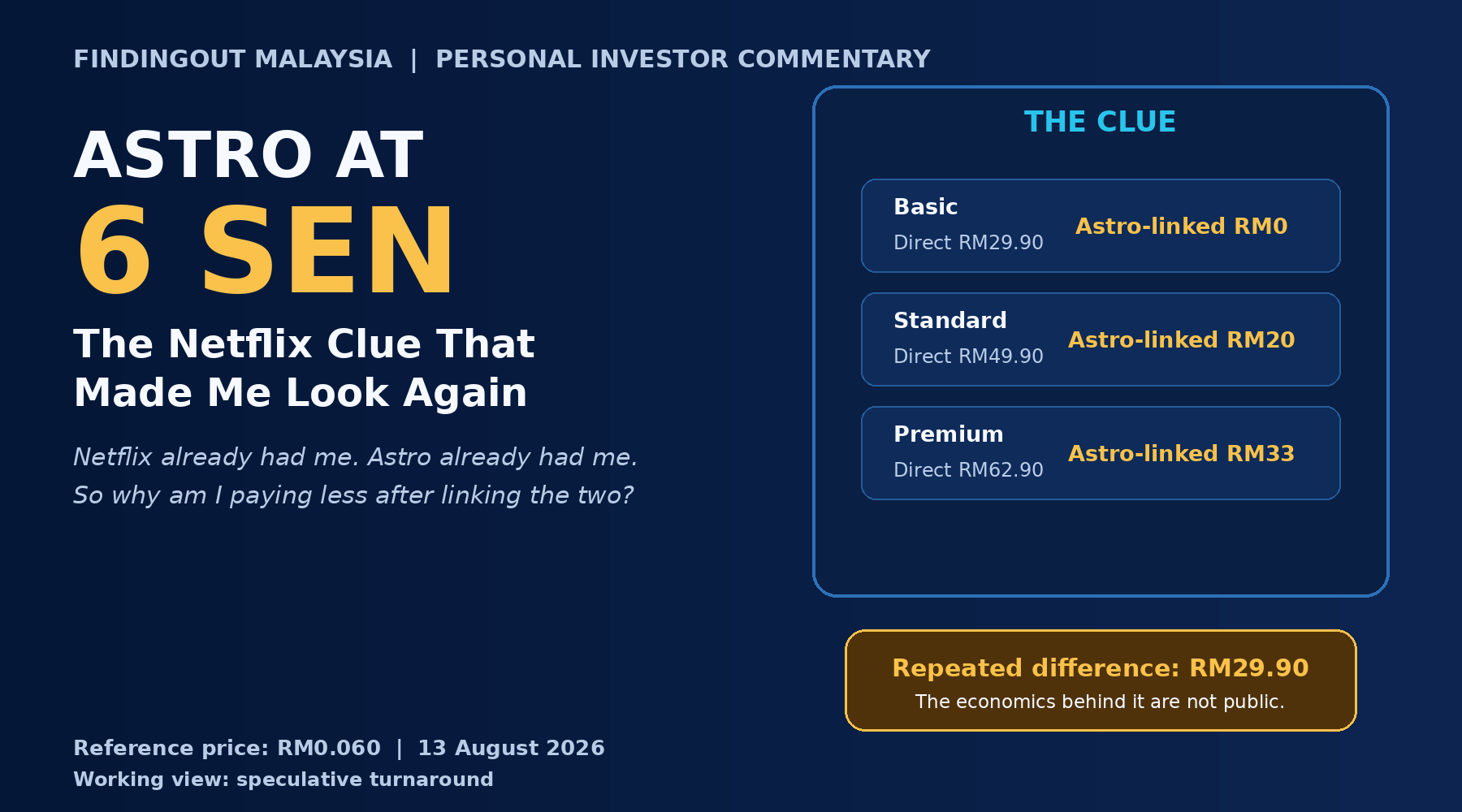
The starting point: a 6-sen reference price and a repeated RM29.90 difference between direct Netflix pricing and the linked prices shown in my account.
Sometimes an investment idea begins with an annual report or a stock screener. This one began with an email from Netflix. I have paid Netflix directly since 2018 and I am also an Astro customer. Until recently, I treated the two as completely separate services. Then I was invited to link my existing Netflix account through Astro.
The price shown after linking the accounts made me stop and think. Netflix already had me as a paying customer. Astro already had me as a customer. Yet the linked arrangement reduced the incremental amount shown to me. That became the clue that made me look again at Astro — not because it proves a turnaround, but because it made me ask what economic value Astro might still have as an aggregator, distributor and long-term customer relationship.
1. The price difference that caught my attention
Inside my linked Netflix account, the prices shown were Basic RM0, Standard RM20 and Premium RM33. Compared with the Malaysian Netflix RRPs of RM29.90, RM49.90 and RM62.90 respectively, every tier showed the same effective difference: RM29.90.
Direct Netflix RRP versus the linked prices displayed in the author’s Netflix account. Account eligibility and package terms may differ between customers.
That repeated RM29.90 is the clue. It is not proof that Astro itself is paying the difference, nor does it tell us how Netflix and Astro divide the economics. Their commercial terms are not publicly disclosed.
Astro’s public Netflix add-on page separately advertises discounted Netflix add-ons for eligible customers on a 24-month contract. That public pricing is not the same as the linked-account pricing above, but it supports the broader idea that Astro is using Netflix as part of a longer customer proposition rather than simply reselling one month of streaming. [5]
What could explain the economics?
Wholesale or bundled pricing: Astro may receive Netflix at a negotiated bundle cost.
Revenue sharing: Astro may retain part of subscriber value when customers sign up through its platform.
Lower churn: a stronger bundle may make households more likely to remain in the Astro ecosystem.
Upselling: Netflix may help Astro cross-sell Sooka, broadband, sports, advertising or other services.
The point is not to guess the confidential contract. The point is that a lower monthly price can still make commercial sense if it creates a longer and more valuable customer relationship.
2. The 24-month angle — and what Astro is trying to become
The 24-month term matters because a direct Netflix subscriber can cancel next month, while a subscriber embedded inside a broader Astro relationship may stay longer. The relevant economics may therefore be less about one month’s price and more about lifetime value, retention and the ability to monetise the same household across several services.
The strategic transition I am watching: from a traditional satellite pay-TV model toward a broader entertainment, streaming and content ecosystem.
My question is not whether Astro can become the old Astro again. It is whether the newer ecosystem can stabilise customers, revenue and cash generation from today’s much lower base.
I took up the Netflix offer myself, and several friends I know have also taken it up. That is anecdotal rather than market evidence, but it raises a useful scale question: could the linked proposition become meaningful if enough Malaysian Netflix users move through Astro?
A simple scale illustration — not a forecast
Netflix does not publish a Malaysia-specific subscriber count. The article uses a third-party FlixPatrol estimate of approximately 2.44 million subscriptions in Malaysia for 2025. Using that only as a working base, the following scenarios show the potential gross-billing scale if 10%, 20% or 30% of that base were linked through Astro at an illustrative RM20 per month. [8]
Illustrative take-up
Linked subscribers
Annual gross billings @ RM20 / month
Equivalent to FY26 revenue
10%
243,750
RM58.5m
2.1%
20%
487,500
RM117.0m
4.2%
30%
731,250
RM175.5m
6.3%
llustrative gross-billing sensitivity only. Depending on contract and accounting treatment, Astro could recognise the full amount, a net commission or another amount entirely.
3. Top line more plausible; bottom line still uncertain
If take-up grows, I would expect some positive economic effect somewhere — through billings, subscription revenue, retention, lower churn, advertising, rebundling or related monetisation. I am much less confident about predicting the bottom line because the commercial split, subsidies and accounting treatment between Netflix and Astro are not public.
Why the top-line thesis is easier to frame than the bottom-line thesis.
Why the market is so pessimistic
The Netflix clue only matters because Astro is already priced for a very difficult future. Revenue fell from RM5.613 billion in FY17 to approximately RM2.790 billion in FY26. PATAMI peaked at RM771 million in FY18 and was only RM63 million in FY26. The share price moved from around RM2.65 at the end of 2017 to 6 sen on 13 August 2026. This is a structural reset, not a one-quarter problem. [1] [2] [3]
4. What does 6 sen actually mean?
A low share price is not the same thing as a low-risk investment. Six sen can still become three sen, one sen or zero. What interests me is the asymmetry if the business merely stabilises from a very depressed base.
Reference valuation snapshot at 6 sen. The implied FY26 P/E and price/sales ratios are simple calculations, not live broker multiples.
At the 6-sen reference price, the approximate market capitalisation is around RM314 million. Against FY26 PATAMI of RM63 million, that implies a simple backward-looking earnings multiple of about 5.0 times. But that number should not be read in isolation. Q1 FY27 PATAMI was only RM2 million, earnings remain volatile and net debt-to-EBITDA stood at 3.0 times. Astro’s official dividend history also shows no dividend after 1QFY24. [4] [9]
The latest quarter is still weak — but there are useful operating signals
Q1 FY27 revenue was RM660 million, PATAMI RM2 million, free cash flow RM100 million and cash and bank balances RM491 million. Pay-TV ARPU was RM93.90. Sooka’s VIP paying subscriber base grew 29% year on year. [4]
Selected Q1 FY27 operating and financial metrics from Astro’s results presentation and release.
5. More than billing: Astro also brings content and reach
Astro describes itself as Malaysia’s largest content creator. In FY26 it produced 11,600 hours of content and offered around 80,000 On Demand videos. In Q1 FY27, six Astro-produced shows appeared in Netflix Malaysia’s Top 10. That tells me the relationship can involve content as well as billing and distribution. [1] [4]
Content and distribution can be another layer of the Astro-Netflix relationship beyond billing.
Could Netflix ever invest in Astro? It is possible in theory, but there is no public evidence today that such an investment is being planned. I would not base an investment thesis on that speculation. Deeper licensing, regional distribution or co-production are more modest possibilities that can exist without an equity transaction.
What would have to go right — and what could still go wrong
The turnaround case is testable: customer trends, streaming monetisation, cash flow and leverage should eventually show whether the thesis is strengthening or weakening.
6. My personal plan: the next two reporting cycles
I have already bought Astro shares, so I have money at risk in this thesis. My initial plan is to watch the next two reporting cycles over roughly four to six months. This is my personal decision, not a recommendation for anyone else.
Astro’s Q2 FY27 ended on 31 July 2026. I will read those results, but I do not expect that quarter alone to settle the question because the newer Netflix promotions may not yet have had enough time to work through customer behaviour. The quarter I am more interested in is Q3 FY27, ending 31 October 2026. By then there should have been more time for take-up, retention effects and any revenue contribution to become visible.
My initial observation period: review Q2 FY27, place greater weight on Q3 FY27, then reassess.
What I will be watching
Whether quarterly revenue begins to stabilise after years of decline.
Whether customer numbers, churn or retention show improvement.
Whether management indicates that streaming partnerships are becoming financially material.
Whether Sooka continues to grow paid subscribers and engagement.
Whether free cash flow remains healthy and leverage remains manageable.
My position for now: a speculative turnaround worth testing against the next results, not a conclusion that the turnaround has already happened.
My conclusion
Netflix already had me. Astro already had me. Yet the two companies found a way to make the linked Netflix proposition materially cheaper for me. That does not prove that Astro is undervalued, and it certainly does not tell us how profitable the Netflix arrangement is.
What it does tell me is that Astro still has something that may be economically useful: a customer relationship, billing platform, distribution reach, local content and a growing set of streaming and digital touchpoints. The old pay-TV business has declined dramatically. The question is whether those remaining assets can be reorganised into a smaller but more durable ecosystem.
At 6 sen, I think that question is interesting enough to watch with my own money. But I do not want to become emotionally attached to it. After the next results — especially Q3 FY27 — I will reassess. Depending on what the evidence shows, I may continue holding, add, reduce or exit. If the evidence changes, the thesis should change.
Disclosure and Important Notice
I currently hold shares in Astro Malaysia Holdings Berhad and therefore have a financial interest in the company discussed in this article. My ownership may influence my interpretation of the company, and readers should take that potential bias into account.
I am not a financial adviser, securities analyst, stockbroker, investment professional or licensed investment adviser. I do not claim to be an expert or to hold any professional qualification in investment analysis. This article records my personal observations and reasoning after studying publicly available information.
Nothing in this article constitutes personalised investment advice, a research recommendation, an offer or a solicitation to buy, sell or hold any security. Investing in shares can result in substantial or complete loss of capital. Readers should conduct their own research and, where appropriate, obtain advice from a properly licensed professional.
The Netflix-Astro commercial terms are not publicly disclosed. The Malaysia Netflix subscriber figure used in the sensitivity analysis is a third-party estimate, not an official Netflix disclosure. The gross-billing illustrations are scenarios only and are not forecasts of Astro revenue or profit. There is no public evidence that Netflix plans to invest in Astro Malaysia Holdings Berhad.
Regulatory note
The Securities Commission Malaysia has clarified that providing investment advice is a regulated activity and that certain financial insights or recommendations shared through social media can cross into regulated activity. A disclaimer alone does not determine whether content is regulated. This article is intentionally framed as personal observation and disclosure of my own decision rather than personalised advice to readers. [12]
Sources and Reference Notes
Astro Integrated Annual Report 2026 — FY26 revenue RM2.8bn, PATAMI RM63m, FCF RM459m, 5.2m TV households, 11,600 content hours and 80,000 On Demand videos. Open source
Astro Integrated Annual Report 2025 — historical group financial review for FY21-FY25. Open source
Astro Integrated Annual Report 2021 — historical group financial review for FY17-FY21. Open source
Astro Q1 FY27 release / presentation — revenue RM660m, PATAMI RM2m, FCF RM100m, ARPU RM93.90, cash RM491m, net debt/EBITDA 3.0x, Sooka VIP +29% YoY, and six Astro-produced Netflix Malaysia Top 10 titles. Open source
Astro Netflix add-on page — current public add-on pricing and 24-month contract terms. Open source
Astro and Netflix strategic partnership — original 2021 announcement. Open source
Netflix partner strategy — statement that Netflix had commercial relationships with more than 160 telco/ISP partners globally. Open source
FlixPatrol — third-party 2025 estimate of 2,437,500 Netflix subscriptions in Malaysia. Open source
Astro official dividend history — latest listed distribution is 1QFY24. Open source
Investing.com historical data — reference close of RM0.060 on 13 August 2026. Open source
Author’s Netflix account — linked pricing displayed in August 2026: Basic RM0; Standard RM20; Premium RM33. This is account-specific and not a general public price claim.
Securities Commission Malaysia — guidance on investment advice and finfluencers. Open source
Share-price chart note: selected historical nominal observations are used for visual context; they are not a continuous total-return series. Valuation snapshot calculations are simple reference-price calculations, not live broker estimates.